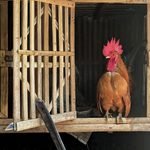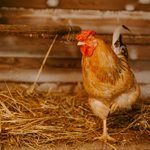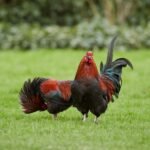
Can you keep a rooster without hens? Yes, a rooster can be kept without hens, but removing hens from the arrangement does not remove his need for appropriate housing, social interaction, exercise, enrichment, and daily care. Chickens are social animals, so the quality of the rooster’s overall environment matters more than simply whether female chickens are present.
A rooster without hens might live alongside compatible male chickens, remain separated while maintaining appropriate contact with other chickens, or require an individual arrangement because of health or management circumstances. What works depends on the bird, the available space, the other chickens involved, and how the setup is managed.
Does a Rooster Need Hens to Survive?
No. A rooster does not biologically require hens in order to eat, drink, sleep, crow, maintain his plumage, or perform other basic functions. He can receive appropriate nutrition and care without living in a traditional flock of hens.
That answer should not be confused with saying that social conditions are irrelevant. Domestic chickens have complex social behavior and normally interact with other members of their species. Removing hens therefore answers only one part of the husbandry question.
The review of chicken cognition and behavior published in Animal Cognition describes the substantial social and cognitive abilities of domestic chickens, including communication, social learning, and awareness of relationships within a group.
Are Roosters Social Animals?
Yes. Domestic chickens naturally form social groups and establish relationships and hierarchies within them. Roosters communicate through vocalizations, body posture, displays, and other behaviors rather than simply sharing physical space with other birds.
This is one reason permanent solitary housing deserves careful consideration. A rooster may be physically safe in an enclosure by himself while still having fewer opportunities for normal social interaction.
Housing decisions should therefore consider both physical requirements and the rooster’s behavioral environment. Space, enrichment, visual surroundings, routine, and opportunities for appropriate social contact can all affect the quality of the setup.
Can a Rooster Live Completely Alone?
A rooster can sometimes be housed alone, particularly when temporary separation is necessary because of quarantine, illness, injury, aggression, breeding management, or introductions to a new flock. In these situations, individual housing can serve an important management purpose.
Permanent isolation is a different question. Because chickens are social animals, keeping a healthy rooster completely separated from other chickens for his entire life should not automatically be considered equivalent to normal group housing.
If individual housing is necessary, provide enough space for normal movement, appropriate roosting, environmental enrichment, good ventilation, suitable food and water, and regular observation. Where safe and appropriate, the arrangement may also allow the rooster to see or hear other chickens without giving him direct access to birds with which he cannot safely live.
Can a Rooster Live With Other Roosters Instead of Hens?
Some roosters can live in male-only groups, sometimes referred to informally as bachelor groups or bachelor flocks. Successful groups depend on the individual birds, available space, introductions, resources, and the stability of the social arrangement.
Keeping several males together does not guarantee harmony. Roosters establish social relationships, and aggression can occur. Introducing new birds, changing the group, providing insufficient space, or creating competition around resources can destabilize an otherwise manageable arrangement.
Male-only housing therefore needs active observation rather than an assumption that removing hens will automatically prevent conflict.
Do Roosters Fight If There Are No Hens?
They can. Rooster aggression is not solely caused by access to hens. Male chickens can establish dominance relationships regardless of whether females are present.
Individual temperament, age, previous social experience, available space, flock stability, and competition for resources can all influence interactions. Two roosters that coexist successfully in one situation may behave differently after the group or environment changes.
Removing hens may alter some social competition, but it should not be treated as a guaranteed method for preventing fighting.
Why Space Matters With Multiple Roosters
Space becomes especially important when several males share an enclosure. A subordinate bird needs opportunities to move away from a more dominant rooster rather than being repeatedly trapped against walls, fences, feeders, or corners.
Providing additional room does not guarantee compatibility, but overcrowding can make social tension harder to manage. Multiple feeding or watering locations may also reduce unnecessary competition where appropriate.
If you are planning housing from scratch, our guide on how much space one rooster needs provides a starting point for evaluating coop and run space before additional birds are added.
Can Two Roosters Live Together Without Hens?
Two roosters may live together successfully, but compatibility cannot be guaranteed. Birds raised together may sometimes establish a workable social relationship, while other pairs may become increasingly aggressive as they mature.
Monitor chasing, repeated attacks, injuries, restricted access to food or water, and situations where one bird spends much of his time attempting to avoid the other. Normal social interactions should not be allowed to progress into persistent injury or severe harassment.
Have a safe separation plan available before housing unfamiliar or potentially incompatible males together. Waiting until a serious fight occurs leaves fewer management options.
Can Several Roosters Form a Bachelor Flock?
Male-only groups can work under suitable conditions, but the number of roosters alone does not determine success. Space, stable membership, individual temperament, resource availability, and the ability of birds to avoid conflict all matter.
Adding or removing birds can alter existing social relationships. A group that has settled into a stable hierarchy may therefore change when a new rooster is introduced.
Regular observation is essential. Look beyond obvious fighting and make sure lower-ranking birds can move freely, eat, drink, roost, and use the enclosure without persistent interference.
Does Keeping Roosters Without Hens Stop Crowing?
No. A rooster does not need hens nearby in order to crow. Crowing is influenced by circadian timing, social status, environmental cues, other roosters, and individual behavior.
Research has shown that an internal biological clock contributes to predawn crowing. Roosters can therefore begin calling before sunrise even when no hen is prompting the behavior.
The Current Biology study on the circadian control of rooster crowing demonstrated that predawn crowing persists under controlled lighting conditions. If noise is the reason you are considering a hen-free setup, removing the hens should not be expected to make the rooster quiet.
Will a Rooster Crow Less Without Hens?
There is no reliable rule that a rooster without hens will crow less. Removing hens changes the social environment, but crowing has several functions and influences beyond interaction with females.
Individual roosters also vary considerably. Some birds crow frequently throughout the day, while others are less vocal. Changes in surroundings, nearby roosters, light, activity, and social conditions can alter the pattern.
Our guide on how often roosters crow explains why there is no standard number of daily crows that applies to every bird.
What Happens If a Rooster Can Hear Other Roosters?
Hearing another rooster can influence crowing behavior even when the birds do not share an enclosure. Roosters communicate vocally and may respond to calls from other males.
Social rank also affects crowing within groups. Research published in Scientific Reports found that higher-ranking roosters generally initiated predawn crowing, while subordinate birds followed the social order.
You can read the Scientific Reports research on social rank and rooster crowing for the experimental findings. Our article on whether roosters crow more when they hear another rooster looks specifically at how males can respond to one another.
Does a Rooster Become Aggressive Without Hens?
Removing hens does not automatically make a rooster aggressive, and keeping hens does not automatically make him calm. Aggression is influenced by the individual bird, social circumstances, handling, maturity, environment, and interactions with other chickens.
A rooster’s behavior can also change as he matures. A young male that was easy to handle before sexual maturity may behave differently as an adult.
Judge the individual rooster by his actual behavior rather than assuming that the presence or absence of hens will determine his temperament.
Does a Rooster Become Lonely Without Hens?
It is difficult to reduce a chicken’s social experience to the human concept of loneliness. What is clear is that chickens are social animals with sophisticated communication and group behavior.
A rooster living without hens may still have social contact with other chickens. A rooster living completely alone has a different environment and should not be assumed to have the same social opportunities as a bird living within a compatible group.
Rather than trying to diagnose a human-like emotion, focus on observable welfare and behavior. Monitor activity, feeding, drinking, movement, vocalization, feather condition, use of enrichment, and changes from the rooster’s normal behavior.
Can Human Attention Replace Other Chickens?
Regular human interaction can form part of a rooster’s daily environment, particularly for a bird accustomed to people. It should not automatically be considered a complete substitute for species-appropriate social opportunities.
Chickens communicate with one another through signals and behaviors that humans cannot fully reproduce. A person can provide care, enrichment, routine, and interaction without becoming the equivalent of another chicken.
If a rooster must live individually, thoughtful human contact can be valuable, but his entire management plan should not depend on constant human attention to compensate for an otherwise restricted environment.
What Does a Rooster Without Hens Still Need?
A rooster without hens needs the same fundamental standard of care as any other chicken. He requires suitable food, clean water, secure shelter, adequate space, appropriate roosting, ventilation, weather protection, sanitation, and protection from predators.
He also benefits from opportunities to perform normal behaviors such as walking, scratching, foraging, dust bathing, stretching, preening, and exploring his environment. An empty enclosure containing only a feeder and waterer may meet basic survival needs without providing a particularly useful behavioral environment.
Enrichment can be simple. Appropriate litter or ground for scratching, safe areas for dust bathing, perches, vegetation where suitable, and opportunities to forage can make the available space more functional.
How Much Space Does a Rooster Without Hens Need?
Removing hens does not mean the rooster can be housed in an extremely small enclosure. His physical space requirements still depend on body size, outdoor access, climate, activity, and how much time he spends confined.
For a standard rooster with regular outdoor access, around 3–4 square feet of usable indoor coop floor and at least 8–10 square feet of outdoor run space provides a practical planning starting point. More room is appropriate for large birds or roosters that spend substantial periods confined.
These figures are general planning guidelines rather than a universal rooster-specific requirement. If you have space available, designing comfortably above a minimum gives the bird more usable room and makes the enclosure easier to manage.
Does a Rooster Without Hens Need a Nesting Box?
No. A rooster does not lay eggs and does not require a nesting box for that purpose.
Removing unnecessary nest boxes can free some room in an individual rooster setup, but the enclosure should still include an appropriate roost and enough usable floor space for movement.
If hens may later join the flock, nesting facilities can be added or incorporated into the future housing plan.
Does a Rooster Need a Roost at Night?
Providing an appropriate perch allows the rooster to perform normal nighttime roosting behavior. The perch should be stable, appropriately sized for the bird, and positioned so that the rooster can access and leave it safely.
Heavy breeds may benefit from lower roosting arrangements because jumping from excessive height can place more force on the legs and feet. The surrounding floor and available landing area should also be considered.
A suitable roost is particularly easy to provide when only one bird uses the enclosure because there is no need to manage competition for the highest position.
Can You Keep a Rooster as a Pet Without Hens?
A rooster can be kept primarily as a companion animal without maintaining a breeding flock of hens. The absence of a breeding purpose does not change the need for appropriate poultry husbandry.
Before choosing this arrangement, consider the rooster’s long-term housing, social environment, noise, local regulations, veterinary care, and what will happen if his behavior or circumstances change.
A pet rooster can live for years, so the setup should be planned as a long-term commitment rather than a temporary novelty.
Can You Keep a Rooster Without Hens in a Backyard?
Yes, where local regulations permit it and the property provides suitable housing. A backyard rooster without hens still needs adequate coop and run space, protection from predators, good sanitation, and appropriate opportunities for activity and social interaction.
Noise remains an important consideration. Removing hens does not remove predawn crowing, and nearby residents may still hear the rooster from inside his coop or while he is outdoors.
If your available space is limited, our guide on keeping a rooster in a small backyard covers the combined issues of space, neighbors, housing, and local restrictions.
Check Local Rules Even If You Have No Hens
Rooster restrictions generally apply to the male bird itself rather than depending on whether hens are also present. Keeping a single rooster therefore does not necessarily avoid poultry or noise regulations.
Local rules vary widely. Depending on the jurisdiction, there may be restrictions involving roosters, livestock, zoning, coop placement, property boundaries, sanitation, or nuisance noise.
Check the current requirements for the exact property before acquiring the bird. Do not assume that keeping only one chicken automatically makes poultry regulations irrelevant.
Neighbor Noise Still Matters
A single rooster can produce enough crowing to affect nearby residents, particularly during quiet predawn hours. The absence of hens does not make the noise problem disappear.
Coop location, distance from bedrooms, housing construction, barriers, morning management, and the surrounding environment all influence how noticeable the bird is to other people.
If neighboring homes are close, see our guide on how to keep a rooster without annoying your neighbors before deciding where to position the enclosure.
Can a Rooster Without Hens Live in a Small Backyard?
Potentially, but removing hens does not automatically make a small property suitable. A single rooster requires less total flock space than a rooster with several hens, yet the property still has to accommodate his coop, outdoor area, sanitation, access, and normal movement.
Crowing may remain the larger limitation. A small backyard surrounded by neighboring bedrooms can create a difficult noise situation even when there is enough physical room for one bird.
Evaluate both the rooster’s needs and the surrounding property rather than judging suitability only by whether an enclosure fits.
When Individual Housing May Be Necessary
There are situations in which temporarily housing a rooster alone is sensible or necessary. A new bird may require quarantine before joining a flock, while an injured or sick bird may need separation for treatment and observation.
A rooster involved in persistent aggression may also require immediate separation while a longer-term management plan is developed. In these cases, individual housing protects the bird or the rest of the flock rather than serving as the default permanent arrangement.
Temporary housing should still provide adequate space, ventilation, food, water, security, and suitable environmental conditions. Emergency separation does not mean basic husbandry requirements can be ignored.
Introducing a Rooster to Other Chickens Later
If a rooster has been living without hens and will later join a flock, avoid assuming that the birds can simply be placed together without adjustment. Chickens establish social relationships, and introductions can temporarily disrupt the existing hierarchy.
A gradual introduction that allows birds to become familiar while preventing immediate unrestricted conflict may make observation easier. Ensure that the enclosure provides enough room and that birds can access essential resources.
Watch the flock closely during the transition. Some chasing and social adjustment may occur, but persistent attacks, injury, or a bird being prevented from eating and drinking requires intervention.
Should You Get Hens Just to Keep a Rooster Company?
Do not add hens solely because you assume a particular number is required to make the rooster happy. Adding birds increases the space, feed, sanitation, veterinary, and management requirements of the entire flock.
A rooster living with hens also introduces mating behavior and different social dynamics. Too much mating pressure on a small number of hens can become a management concern, so adding females is not a simple solution to every rooster-housing problem.
Build the flock you can house and manage appropriately rather than acquiring additional chickens without considering their long-term needs.
Is a Hen-Free Setup Right for Your Rooster?
A hen-free setup is more likely to work when the rooster has appropriate housing, sufficient room, enrichment, careful daily observation, and suitable opportunities for social contact. If other roosters are involved, their compatibility and social stability also need ongoing attention.
The arrangement becomes less suitable when the rooster spends most of his life in a tiny, empty enclosure simply because there are no hens to share the space. Removing flock members should not be used as justification for reducing the quality of the remaining bird’s environment.
Judge the setup by the rooster’s complete living conditions rather than by the presence or absence of female chickens.
Frequently Asked Questions
Can you keep a rooster without hens permanently?
Can you keep a rooster without hens permanently? Potentially, yes, but the rooster still needs an appropriate social and physical environment. Chickens are social animals, so long-term complete isolation should not be treated as equivalent to living within a compatible group.
Will a rooster be unhappy without hens?
The absence of hens alone does not tell you whether a rooster has an appropriate environment. Consider his social opportunities, behavior, space, enrichment, health, and daily routine rather than trying to judge welfare from the presence of females alone.
Can two roosters live together without hens?
They sometimes can, but compatibility varies. Provide sufficient space and resources, monitor interactions carefully, and have a safe way to separate the birds if aggression becomes persistent or causes injury.
Do roosters need hens to crow?
No. Roosters crow without hens. Crowing is influenced by internal biological timing, social conditions, environmental cues, and individual behavior.
Will a rooster stop crowing if there are no hens?
No. Removing hens should not be expected to stop crowing. A rooster may continue to crow before dawn and throughout the day.
Can a rooster live alone as a pet?
A rooster can be kept as a companion animal, but permanent individual housing should still provide adequate space, enrichment, appropriate care, and consideration of the bird’s social nature.
Does a rooster without hens need less space?
A single rooster requires less total flock space than several chickens, but his individual needs do not disappear. He still requires enough indoor and outdoor space for normal movement, roosting, activity, and appropriate husbandry.
Final Thoughts
Can you keep a rooster without hens? Yes. Hens are not required for a rooster’s basic survival, and some roosters are kept successfully without a traditional group of females. However, chickens are social animals, so removing hens does not remove the need to consider social interaction and behavioral opportunities.
A rooster without hens still needs suitable housing, adequate space, good ventilation, secure shelter, enrichment, sanitation, and careful daily observation. If he lives with other roosters, compatibility and social hierarchy require attention. If he lives individually, the quality of his social and physical environment becomes particularly important.
Do not add hens simply because you believe every rooster must have them, and do not isolate a rooster permanently simply because individual housing is convenient. Plan the arrangement around the needs and behavior of the actual bird, the space you can provide, and the long-term standard of care you can maintain.