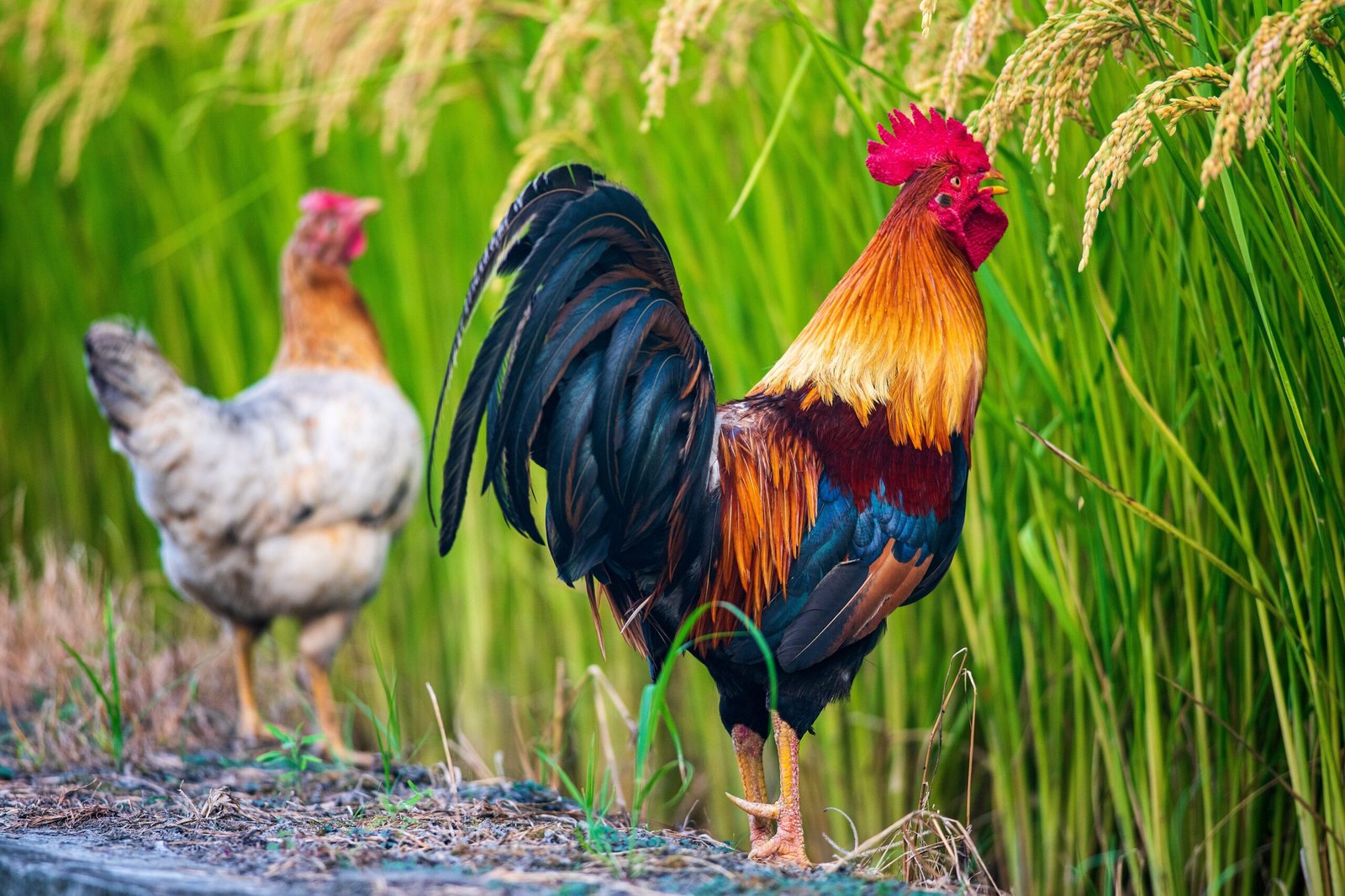
Do roosters crow more when they hear another rooster? They can. Hearing another rooster can stimulate crowing, and roosters living within hearing distance often appear to answer one another. However, the relationship is more complex than every rooster simply trying to crow more than his neighbors. Scientific research shows that social rank, internal biological rhythms, and external crowing signals can all influence when a rooster calls.
This helps explain why one crow can sometimes be followed by calls from several other roosters nearby. It also explains why adding another male to the environment can change the pattern of crowing without necessarily affecting every rooster in exactly the same way.
Why Do Roosters Crow When They Hear Another Rooster?
Crowing is a form of communication as well as a familiar feature of the rooster’s daily rhythm. A rooster can hear the calls of other males and respond vocally, particularly when those birds are close enough for their calls to be clearly detected.
Researchers studying rooster crowing have demonstrated that external crowing sounds can act as stimuli. Research published in Current Biology through ScienceDirect examined both internally timed predawn crowing and crowing induced by external stimuli. The findings showed that a rooster’s internal circadian system influences these responses rather than crowing being controlled solely by immediate environmental events.
In practical terms, another rooster’s call can contribute to vocal activity, but the responding bird still has his own biological and social influences affecting when he crows.
Do Roosters Actually Answer Each Other?
Anyone living within hearing distance of several roosters may notice a familiar sequence: one rooster crows, another responds, and additional calls follow from elsewhere.
There is scientific support for socially organized crowing. A study published in Scientific Reports examined groups of four roosters and found that social rank influenced the order of predawn crowing. The highest-ranking rooster generally crowed first, followed by subordinate birds according to their position in the hierarchy.
This means what sounds like a casual exchange between roosters can have an underlying social structure. The birds are not necessarily producing calls randomly.
Does the Dominant Rooster Crow First?
In the controlled groups examined in the Scientific Reports study, the dominant rooster generally initiated predawn crowing. The researchers then observed something particularly revealing when they removed the highest-ranking bird.
The second-ranking rooster became the first bird to crow, effectively assuming the dominant bird’s position in the morning sequence. This provided evidence that social hierarchy, rather than a fixed characteristic of one particular bird, influenced the order.
The study also found that lower-ranking roosters tended to crow less frequently in the presence of the dominant male. This is important because another rooster’s presence can both stimulate and suppress aspects of crowing depending on the social relationship.
Does Hearing Another Rooster Always Cause More Crowing?
No. Hearing another rooster does not guarantee that every bird will immediately begin crowing or that the total number of calls will always increase.
Social rank complicates the relationship. A dominant rooster may initiate calls, while subordinate males may alter their timing or frequency in response to him. The time of day and the responding bird’s internal circadian state can also influence whether an external call produces a response.
So while rooster-to-rooster stimulation is real, it is more accurate to describe crowing as socially influenced rather than to assume every call automatically creates another.
Why Do Roosters Crow Back and Forth?
Repeated exchanges between roosters can occur when males are within hearing distance. Each bird’s call becomes part of the acoustic environment experienced by the others.
Crowing itself also carries information. Research published in Scientific Reports examined individual differences in domestic rooster crows and found that characteristics of the calls could be individually distinctive. In other words, rooster crows contain acoustic features that can differ consistently between individuals.
This supports a broader understanding of crowing as meaningful communication rather than simply undirected noise.
Can Roosters Recognize Other Roosters by Their Crow?
Research shows that rooster crows contain individually distinctive acoustic characteristics, although that finding should not be stretched into claiming that every rooster can identify every neighboring male solely from his crow under all conditions.
Chickens have sophisticated social abilities more broadly. A review published in the journal Animal Cognition examined evidence for complex cognition, communication, and social behavior in domestic chickens. The paper is available through Springer Nature.
What we can say confidently is that crowing functions within a social environment and that individual rooster calls are not acoustically identical.
Can a Neighbor’s Rooster Make Your Rooster Crow?
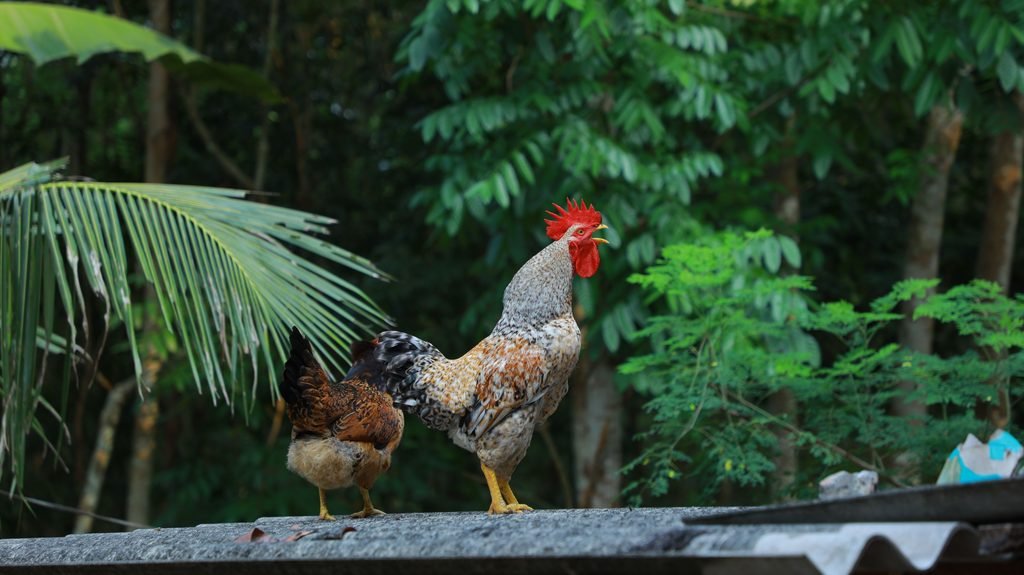
Yes, a neighboring rooster can potentially stimulate a response if your rooster can hear him. The two birds do not need to share the same enclosure for sound to travel between them.
This can explain situations where one rooster begins calling and another bird on a neighboring property soon follows. However, hearing the neighbor is only one factor. Your rooster’s normal daily rhythm, social tendencies, and surrounding environment also affect his response.
If the pattern happens consistently, observing which bird appears to start the sequence can help you understand whether neighboring crowing is contributing to your rooster’s behavior.
How Far Away Can Roosters Hear Each Other?
There is no useful universal distance at which one rooster will stop hearing or responding to another. Sound transmission changes with terrain, buildings, vegetation, background noise, weather conditions, the characteristics of the call, and the positions of both birds.
For that reason, claims that roosters will always hear each other at a particular number of feet, yards, or miles should be treated cautiously unless they refer to a specific measured environment.
A practical observation is more useful: if you can clearly hear a neighboring rooster from your own flock’s housing area, it is reasonable to consider that call part of your rooster’s acoustic environment.
Do Roosters Crow More When There Are Several Roosters?
Keeping several males within hearing distance can create a more complicated vocal environment, but it does not produce a simple mathematical increase in crowing.
Dominance relationships matter. Research on grouped roosters found that higher-ranking birds tended to crow more frequently than lower-ranking birds and that subordinate crowing was affected by the presence of the dominant male.
Removing the dominant rooster also changed the group’s crowing hierarchy, showing that the behavior was flexible in response to social conditions.
This is one reason our guide explaining how often roosters crow avoids giving a universal number of daily calls.
Do Roosters Compete With Each Other by Crowing?
Crowing is associated with male social behavior and status, so competition is relevant, but describing every exchange as a deliberate contest to produce the most noise would oversimplify the behavior.
Domestic chickens form social hierarchies, and crowing patterns can reflect those relationships. The dominant bird’s tendency to lead the predawn sequence is one clear example.
It is therefore more accurate to view crowing as part of rooster social communication and hierarchy rather than as a simple volume competition.
Why Does One Rooster Start and All the Others Follow?
This pattern is particularly interesting around dawn. Each rooster has an internal circadian rhythm, yet social hierarchy can influence the order in which a group begins calling.
The dominant bird may start the sequence, with subordinate birds following afterward. This means the first rooster is not necessarily waking all of the others from an otherwise inactive state. Their internal clocks may already be preparing them for predawn activity, while the social structure helps determine the order in which they vocalize.
This interaction between biology and social behavior is one reason morning crowing can sound so coordinated.
Do Roosters Crow at Each Other Before Sunrise?
Yes. Socially influenced crowing can occur during the predawn period, before visible sunrise.
Roosters possess an internal biological clock that allows them to anticipate dawn. Nagoya University’s research summary explains how experiments demonstrated internally controlled predawn crowing even when normal sunrise cues were removed.
Our guide on roosters crowing while it is still dark covers this circadian mechanism in more detail.
Can Another Rooster Cause Earlier Morning Crowing?
Another rooster’s calls may act as an external stimulus, but it would be misleading to assume that a neighboring bird completely determines when your rooster wakes and starts crowing.
The rooster’s circadian system remains important. Research suggests that responses to external crowing stimuli can vary according to biological time, meaning the same stimulus does not necessarily have an identical effect at every hour.
If a rooster consistently starts extremely early, consider both his biological rhythm and his environment rather than assuming the neighboring rooster is solely responsible.
Our article explaining why a rooster may crow at 4 AM examines this early-morning timing more closely.
Can Recorded Rooster Crowing Trigger a Response?

Experimental research has used recorded crowing as an external stimulus and demonstrated that roosters can respond to crowing sounds. This provides stronger evidence than relying only on backyard observations of birds apparently answering one another.
However, the response is affected by biological timing. The original circadian research found that externally induced crowing was also regulated by the internal clock.
This means hearing a recorded rooster can potentially provoke a response, but it does not mean a rooster will respond identically every time a crowing sound is played.
Why Does My Rooster Crow When He Hears One Far Away?
A distant rooster may still be audible even when the birds cannot see each other. Visual contact is not required for one bird’s call to become an acoustic stimulus for another.
How strongly your rooster responds can vary. Some birds may participate readily in repeated exchanges, while others may respond less frequently.
The surrounding soundscape matters as well. Rooster calls can be especially noticeable in the early morning when traffic and other background sounds are relatively low.
Can You Reduce Crowing Caused by Other Roosters?
This can be difficult when the other rooster is on a neighboring property because you cannot control the external sound source. Preventing visual contact also does not necessarily prevent acoustic communication.
Rather than trying to eliminate every response, focus on the factors you can reasonably control. Appropriate coop location, a consistent nighttime environment, reduction of unnecessary artificial lighting, and avoiding preventable disturbances can all form part of broader noise management.
Our practical guide to reducing early-morning rooster crowing covers these management options without promising that natural crowing can be eliminated.
Will a Dark Coop Stop a Rooster Responding to Another Rooster?
Not reliably. Making the coop dark removes visual light cues but does not prevent the rooster from hearing another bird. It also does not disable the internal circadian system involved in predawn crowing.
A rooster may therefore remain in a dark enclosure and still participate in an early-morning crowing sequence.
For a detailed explanation, see our guide asking whether a dark coop can stop a rooster crowing early.
Does Breed Affect How Roosters Respond to Each Other?
Individual breeds can differ in many physical and behavioral traits, but there is not enough controlled comparative evidence to rank common chicken breeds reliably according to how strongly their roosters respond to another male’s crow.
Individual personality, social position, previous experience, age, environment, and flock composition can all complicate breed comparisons.
For that reason, choosing a particular breed should not be treated as a guarantee that the rooster will ignore neighboring males or remain quiet when another bird starts crowing.
What If Two Roosters Keep Crowing Back and Forth?
Repeated exchanges may simply reflect normal social vocalization, particularly when the birds are otherwise behaving normally. Trying to identify which bird initiates the sequence and when it occurs can reveal useful patterns.
If the main problem is noise rather than the birds’ behavior itself, consider frequency, timing, housing location, and proximity to neighboring homes. Repeated calls during quiet predawn hours can have a much greater practical impact than the same number of calls later in the day.
Crowing should also be distinguished from physical aggression. If multiple roosters share an enclosure and are fighting or injuring one another, that is a flock-management issue rather than merely a noise issue.
Does Hearing Another Rooster Mean Something Is Wrong?
No. Responding to other roosters is consistent with the social nature of chicken behavior. A rooster crowing after hearing another male is not, by itself, evidence of stress, illness, or abnormal behavior.
The broader context matters. Sudden behavioral changes accompanied by injury, weakness, breathing difficulty, reduced appetite, or other concerning signs should be assessed separately rather than attributed automatically to normal rooster communication.
Frequently Asked Questions
Do roosters crow more when they hear another rooster nearby?
Do roosters crow more when they hear another rooster nearby? They may respond with additional crowing, but social hierarchy and biological timing also influence the response. Another rooster does not automatically cause every bird to crow more frequently.
Why does my rooster answer the neighbor’s rooster?
Crowing functions within rooster social communication, and another rooster’s call can act as an external stimulus. Your rooster may therefore respond even when the other bird is on a separate property.
Does the dominant rooster always crow first?
Research on small groups of roosters found that the highest-ranking bird generally initiated predawn crowing, followed by subordinate males according to social rank. This should not be interpreted as a guarantee for every flock in every situation.
Can roosters hear each other without seeing each other?
Yes. Visual contact is not necessary for one rooster to hear another’s call. Walls, fencing, vegetation, distance, and background noise can affect sound transmission, but blocking the view alone does not prevent acoustic communication.
Will separating two roosters stop them crowing at each other?
Physical separation may change their social environment, but if the birds remain within hearing distance they may still respond to each other’s calls. Separation also does not eliminate their normal circadian crowing behavior.
Do roosters crow to show dominance?
Crowing is associated with social hierarchy and male communication. Research shows that dominance influences the timing and frequency of predawn crowing, although rooster communication is more complex than a simple declaration of dominance with every call.
Final Thoughts on Roosters Hearing Other Roosters
Do roosters crow more when they hear another rooster? Another rooster’s call can stimulate a response, and groups of roosters can produce recognizable sequences of crowing. However, hearing another bird is only one part of the explanation.
Scientific research shows that social hierarchy can determine which rooster initiates predawn crowing and influence how frequently subordinate birds call. At the same time, each rooster’s circadian clock affects when he is biologically prepared to crow and respond to external sounds.
The familiar back-and-forth exchange between neighboring roosters is therefore best understood as a combination of communication, social relationships, external stimulation, and internal biological timing rather than simply two birds competing to make the most noise.