Will a dark coop stop a rooster crowing early? Not reliably. Keeping a rooster’s sleeping area dark can reduce exposure to artificial light and immediate morning light, but darkness does not switch off the biological system behind predawn crowing. Roosters have an internal circadian clock that helps them anticipate the beginning of the day before sunrise occurs.
A darker nighttime environment can still be useful when unnecessary artificial light is reaching the coop. The important distinction is that reducing light exposure may remove one external stimulus, while the rooster’s internal biological rhythm can continue to produce early-morning crowing.
Why Do Roosters Crow Before the Sun Comes Up?
Roosters are famous for crowing around sunrise, but the rising sun itself is not required for them to begin. Research has demonstrated that their predawn crowing is regulated partly by an internal circadian clock.
Researchers at Nagoya University studied roosters under controlled lighting conditions and found that the birds anticipated the beginning of the day even when normal sunrise cues were removed. Nagoya University’s research summary explains that the rooster’s biological clock plays a central role in determining when predawn crowing begins.
This helps explain why a rooster can start calling while his surroundings still look completely dark. Our guide explaining why roosters crow while it is still dark looks more closely at this behavior.
Will Making the Coop Completely Dark Stop Crowing?
Making the sleeping area darker does not guarantee that a rooster will remain silent until daylight. Controlled research found that roosters maintained rhythmic predawn crowing even when kept under constant dim-light conditions.
The original study, published in Current Biology through ScienceDirect, concluded that predawn crowing is controlled by a circadian clock. The researchers also found that external stimuli such as light and the crowing of other birds can induce crowing, but those responses are themselves influenced by the biological clock.
Darkness can therefore change one part of the rooster’s environment without eliminating his internal sense of time.
How Does a Rooster Know When Dawn Is Coming?
A circadian clock is an internal timing system that organizes biological and behavioral activity over an approximately 24-hour cycle. Environmental light helps synchronize these rhythms, but an established rhythm can continue temporarily without an immediate sunrise signal.
In the rooster experiments, birds were first exposed to regular periods of light and dim light. Researchers then kept them under continuous dim conditions. The birds continued to show a daily crowing rhythm, demonstrating that they were not simply waiting to see morning light before calling.
A useful explanation of the experiment is also available from National Geographic, which describes how the birds continued anticipating dawn in a darkened environment.
Can a Dark Coop Make a Rooster Crow Later?
A darker environment may reduce immediate light stimulation, particularly when artificial lighting was previously reaching the rooster at night. However, there is not good evidence that simply darkening a normal backyard coop will reliably move a rooster’s first crow to a later time chosen by the owner.
This distinction matters. A rooster exposed to a bright security light during the night has a different environment from a rooster resting in normal darkness. Removing unnecessary artificial illumination may improve the consistency of the dark period, but it does not erase the rooster’s circadian rhythm.
If early crowing is causing a practical problem, our broader guide on how to reduce early-morning rooster crowing covers several factors worth checking beyond light alone.
Does Artificial Light Make Roosters Crow Earlier?
Light can influence chicken behavior, and artificial lighting is widely used in poultry management because birds respond strongly to photoperiod. Penn State Extension notes that lighting schedules can influence poultry physiology and recommends maintaining a dark period rather than providing continuous light.
Its guidance on artificial lighting for poultry also emphasizes gradual, controlled lighting schedules rather than excessive illumination.
For a backyard rooster, this means unnecessary overnight lighting is worth checking. Porch lights, security lights, coop bulbs, vehicle headlights, and nearby outdoor lighting may alter the nighttime environment.
Removing an unnecessary light source is reasonable, but it should not be presented as a guaranteed cure for early crowing.
Should You Turn the Coop Lights Off at Night?
A normal dark period is appropriate for chickens. If there is no management reason for a light to remain on overnight, continuous bright illumination is unnecessary and may interfere with normal rest patterns.
Lights used around the coop should also be installed safely. Dust, bedding, electrical wiring, and poultry housing can create fire and electrical risks when unsuitable equipment is used.
The objective should be to provide an appropriate day-night environment rather than trying to manipulate a rooster into complete silence.
Should You Cover a Rooster Coop to Keep It Dark?
This is where darkness can become a housing-safety issue. Covering a window or preventing direct artificial light from shining into a coop is very different from wrapping or sealing the entire enclosure.
A chicken coop needs adequate air exchange. Penn State Extension’s poultry housing guidance explains that ventilation removes excess moisture, ammonia, carbon dioxide, and stale air while bringing fresh air into the building.
Do not block ventilation openings or tightly seal the coop simply to make the interior darker. Noise and light management should never create poor air quality, excessive heat, condensation, or other unsafe conditions.
Does a Blackout Cover Stop a Rooster Crowing?
A blackout material may reduce light entering through a particular opening, but it cannot reliably prevent biologically timed predawn crowing. The rooster’s internal clock remains active even when the immediate environment is dim.
There is also an important practical problem with using heavy coverings: materials placed over vents, windows, or large sections of the coop can reduce airflow.
If a particular window is allowing an unwanted security light to shine directly onto the roost, addressing that specific light path may be reasonable. Completely enclosing the coop in blackout material is a different matter and should not compromise ventilation.
What About Keeping the Rooster in the Coop Longer?
Keeping a rooster inside after he begins crowing does not necessarily stop the crowing itself. It simply changes where the sound originates.
The practical effect depends heavily on the construction and location of the housing. A solid, appropriately ventilated coop may change how sound reaches nearby homes, but it should not be treated as a soundproof chamber.
A rooster that begins his normal predawn sequence can continue vocalizing whether or not the door has been opened for the day.
Why Is My Rooster Crowing at 4 AM Even in a Dark Coop?
A consistent early start is exactly the type of behavior that an internal circadian rhythm can help explain. The rooster does not need to look outside, see the sun, and decide that morning has arrived.
Season, individual variation, environmental conditions, and the rooster’s established daily rhythm can all affect when his first calls are heard.
Our article on why a rooster may crow at 4 AM explains why that specific clock time should not be treated as either a universal rooster schedule or automatic evidence that something is wrong.
Why Does My Rooster Crow After I Cover the Coop?
If a rooster continues crowing after his coop has been darkened, that does not mean the covering has failed to block light. It may simply demonstrate that light was never the only factor controlling his crowing.
The circadian clock can generate anticipatory predawn behavior, while other environmental and social stimuli can also influence vocalization.
Other roosters are particularly relevant. A nearby rooster beginning his morning sequence may be followed by others within hearing distance, so eliminating visible light does not eliminate every potential stimulus.
Can Other Roosters Cause Early Crowing?
Rooster crowing has a strong social component. Research has found that social hierarchy influences which rooster begins the predawn sequence when males are housed together.
A study published by Scientific Reports found that the highest-ranking rooster generally initiated predawn crowing, with subordinate males following in order of social rank. When the dominant bird was removed, the second-ranking rooster assumed the leading role.
This demonstrates why focusing exclusively on darkness can miss an important part of the behavior. Roosters respond within a social environment as well as to light and their internal clocks.
Can Noise or Disturbances Cause Crowing in a Dark Coop?
A dark environment does not make a rooster completely unresponsive. Sounds and activity can still disturb resting birds.
Vehicles, people, dogs, wildlife, movement around the enclosure, or other chickens may coincide with nighttime vocalization. If a rooster suddenly starts crowing at an unusual hour, look for patterns in the surrounding environment rather than assuming that the darkness should have kept him silent.
Our guide to why a rooster may crow at night covers the difference between normal predawn behavior and calls associated with nighttime disturbances.
How Dark Should a Rooster Coop Be at Night?
There is no evidence-based backyard rule requiring a rooster’s coop to reach a specific darkness measurement to prevent crowing. Trying to achieve absolute darkness for the sole purpose of suppressing crowing is therefore unnecessary.
A more practical objective is a normal, consistent nighttime environment without unnecessary bright artificial illumination shining directly onto the birds.
The housing must still provide adequate ventilation, safe temperatures, protection from weather and predators, and sufficient space. Darkness is only one environmental factor and should not override these more fundamental requirements.
Is a Dark Coop Better Than Leaving a Light On?
For normal nighttime rest, chickens should have a dark period rather than continuous bright light. However, the question becomes more complicated when lighting is used for specific poultry-management purposes.
For a typical backyard rooster where the concern is unnecessary overnight illumination, eliminating a bright light that serves no useful purpose is reasonable. That does not mean the coop needs to be transformed into a completely lightproof box.
The goal is a suitable nighttime environment, not maximum possible darkness.
Will Darkness Reduce How Often a Rooster Crows?
There is no dependable formula showing that making a coop progressively darker will reduce crowing by a predictable amount. Crowing frequency differs between individual roosters and is influenced by more than light exposure.
Social position, time of day, environmental stimuli, and individual behavior can all contribute. A rooster may produce repeated sequences in the morning even when his sleeping environment remains dark.
For more on frequency, see our guide explaining how often roosters crow.
What Can You Do Instead of Simply Making the Coop Dark?
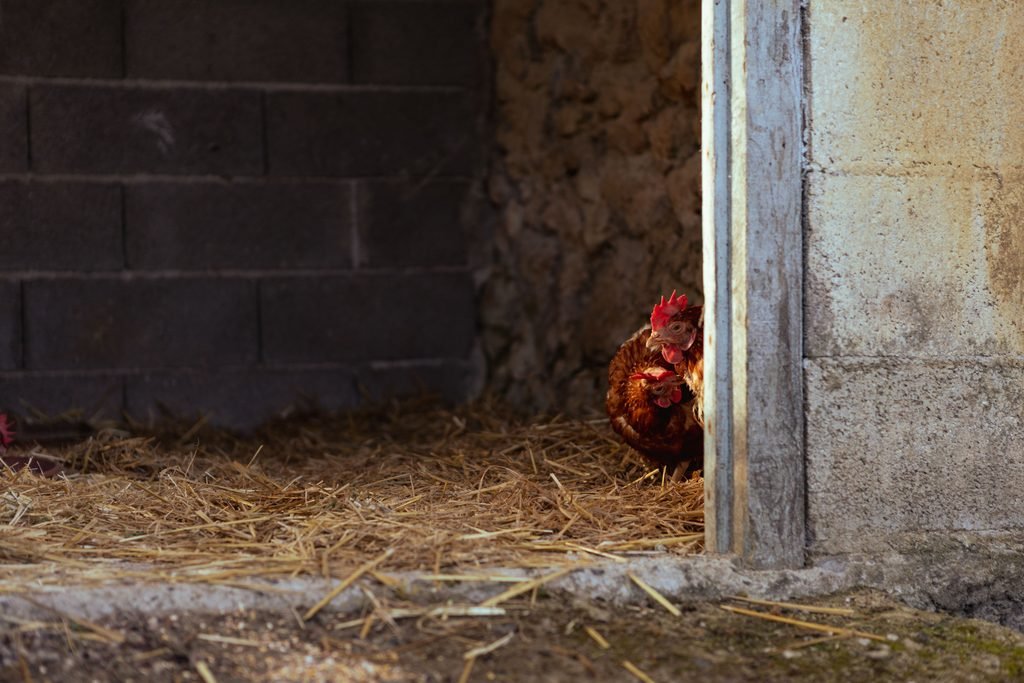
If early crowing is causing a problem, begin by identifying factors that can realistically be changed. Remove unnecessary artificial light that reaches the roosting area. Look for repeated disturbances around the coop. Check whether neighboring roosters are contributing to the morning sequence, and consider whether the coop’s location makes the sound unnecessarily intrusive.
Housing can also be designed with noise impact in mind, provided ventilation, temperature control, predator protection, and the rooster’s other needs remain the priority.
Most importantly, set realistic expectations. Management may reduce avoidable triggers or the impact of crowing, but a healthy rooster cannot reasonably be expected never to crow before sunrise.
What Should You Avoid?
Do not seal ventilation openings, tightly wrap the coop, or create an excessively hot or poorly ventilated enclosure in an attempt to achieve total darkness or contain sound.
Do not deprive the rooster of normal access to food or water or use frightening or painful punishment to discourage crowing. Crowing is an innate behavior, and management should focus on the environment rather than harming the bird for expressing it.
If rooster noise cannot be managed appropriately for the property, local rules and the suitability of the location may ultimately matter more than trying increasingly restrictive methods to suppress natural behavior.
Frequently Asked Questions
Will a dark coop stop a rooster crowing early every morning?
Will a dark coop stop a rooster crowing early every morning? No reliable evidence shows that it will. Darkness may remove immediate light stimulation, but a rooster’s internal circadian clock can still produce predawn crowing.
Can roosters crow in complete darkness?
Roosters can crow without seeing a normal sunrise. Controlled experiments found that they maintained rhythmic predawn crowing under constant dim-light conditions.
Will covering the coop make my rooster sleep longer?
Blocking an unwanted artificial light source may improve the nighttime environment, but covering the coop does not guarantee that a rooster will remain quiet longer. Never block necessary ventilation to make the housing darker.
Should I leave a light on for my rooster overnight?
A rooster does not normally need continuous bright light throughout the night. Chickens require an appropriate light-dark cycle, although specific flock-management circumstances may involve controlled lighting schedules.
Why does my rooster crow before sunrise if he cannot see outside?
His internal circadian clock helps him anticipate the beginning of the day. Visible sunrise is therefore not necessary for normal predawn crowing.
Can artificial light make early crowing worse?
Artificial light can act as an environmental stimulus and can influence poultry behavior. Removing unnecessary overnight illumination is reasonable, but doing so cannot guarantee that normal predawn crowing will stop.
Final Thoughts on Keeping a Rooster Coop Dark
Will a dark coop stop a rooster crowing early? It may reduce unnecessary light-related stimulation, but it cannot reliably eliminate predawn crowing. Scientific research shows that roosters possess an internal circadian clock that allows them to anticipate dawn even without a normal sunrise cue.
A sensible approach is to provide a consistent nighttime environment, reduce unnecessary artificial light, investigate disturbances, and consider how the coop’s location affects the people nearby. Darkness can be one part of that strategy, but it is not a guaranteed solution.
Most importantly, never sacrifice ventilation, temperature control, or basic welfare to make a coop darker. The realistic goal is to reduce avoidable triggers and manage the impact of early crowing, not to prevent a rooster from expressing normal behavior altogether.