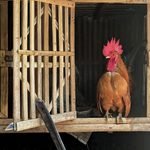
Does keeping a rooster in the coop longer reduce noise? It can reduce how much early-morning crowing reaches nearby people if the coop itself provides meaningful sound reduction, but keeping a rooster inside does not stop him from crowing. The practical effect depends heavily on the construction, ventilation, location, and size of the coop.
A solid enclosed coop may muffle some crowing compared with a rooster calling outside in an open run. However, delaying release should not mean confining a rooster in an unsuitable, hot, poorly ventilated, overcrowded, or excessively dark enclosure simply to keep the neighborhood quiet.
Why Keeping a Rooster Inside Can Make Crowing Less Noticeable
A rooster crowing outdoors has relatively little between his voice and the surrounding environment. When he crows inside an enclosed structure, walls, doors, roofing, insulation, and other building components can reduce some of the sound transmitted outside.
That does not mean an ordinary chicken coop is soundproof. Crowing can still travel through walls, doors, windows, gaps, and especially ventilation openings.
The amount of reduction therefore depends on the entire structure. A substantial enclosed coop may provide noticeably more attenuation than an open-front shelter or lightweight structure covered mainly with wire.
Our guide on how to soundproof a rooster coop safely explains the difference between realistic sound reduction and attempting to create an airtight enclosure.
Does Keeping a Rooster Inside Stop Him From Crowing?
No. Keeping a rooster inside changes where the crow occurs; it does not eliminate the biological motivation to produce it.
Roosters possess an internal circadian rhythm that helps regulate predawn crowing. Research from Nagoya University demonstrated that roosters continued showing anticipatory predawn crowing under controlled dim-light conditions.
Nagoya University’s research summary explains how the experiments showed that an internal biological clock plays an important role in determining when roosters begin their predawn calls.
A rooster can therefore start crowing inside the coop well before you open the door.
Can the Coop Muffle Early-Morning Crowing?
Potentially, yes. This is the strongest reason someone might consider delaying morning release.
If the coop has solid walls and a substantial door, some sound energy must pass through those building components before reaching the surrounding area. The enclosure may therefore reduce the practical impact compared with the same rooster crowing outside.
But the effect cannot be predicted with one universal number. Coop materials, wall construction, roof construction, doors, gaps, vents, distance, and the surrounding environment all influence the result.
A lightweight coop with large open vents may provide relatively little sound isolation, while a more substantial structure may perform differently.
Will Keeping the Coop Door Closed Help?
A closed solid door may reduce one direct sound path compared with leaving a large doorway completely open.
However, the rest of the building matters. Sound can still escape through ventilation openings, thin walls, windows, roofing, and construction gaps.
Closing the main door should also never eliminate necessary ventilation. A coop still needs fresh-air exchange while the birds remain inside.
This is why simply keeping a door shut cannot be treated as a complete rooster-noise solution.
Why Ventilation Still Matters in the Morning
Keeping chickens inside longer can make ventilation even more important because the birds continue producing heat, moisture, carbon dioxide, and waste while occupying the enclosure.
University of Minnesota Extension’s poultry housing guidance emphasizes the need for adequate ventilation in poultry housing to manage moisture and maintain appropriate conditions.
Do not cover ventilation openings with blankets, boards, foam, or other materials simply because the rooster is remaining inside for an additional period.
If noise is escaping through the vents, our guide to soundproofing a rooster coop without blocking ventilation explains safer ways to think about the airflow-versus-noise problem.
Can You Leave a Rooster in the Coop Until Everyone Is Awake?
There is no universal clock time at which every rooster should be released. Sunrise changes seasonally, climates differ, coop designs vary, and management routines are not identical.
A short delay in access to an outdoor area is very different from keeping a bird confined for much of the day solely to suppress noise.
If a rooster remains inside after dawn, the enclosure needs sufficient space, ventilation, appropriate temperature, access to necessities such as water, and suitable conditions for every bird sharing the space.
The goal should not be to find the latest possible time you can keep the rooster locked away. It should be to determine whether a reasonable morning routine reduces noise without compromising normal husbandry.
How Long Is Too Long to Keep a Rooster in the Coop?
There is no responsible universal answer such as 7 AM, 8 AM, or a fixed number of hours.
The appropriate management depends on the size and design of the housing, weather, temperature, flock composition, access to food and water, ventilation, and whether the birds have sufficient usable space.
A spacious poultry house designed for birds to spend substantial time indoors is very different from a small sleeping box intended primarily for overnight roosting.
That distinction is more useful than choosing an arbitrary release time from the internet.
What Happens in Hot Weather?
Hot weather can make delayed release much more problematic.
Sunlight reaching the roof or walls can increase the temperature inside an enclosure, while the birds themselves produce heat. A housing strategy that appears workable on a cool morning may become inappropriate during hot conditions.
University of Minnesota Extension’s heat-stress guidance explains that high temperatures can lead to heat stress in poultry and emphasizes ventilation and access to cool water as important management considerations.
Never keep a rooster confined in an overheating structure simply to postpone the point at which his crowing becomes more audible outside.
What About Cold Weather?
Cold conditions do not eliminate the need for ventilation. Poultry continue producing moisture through respiration and manure even when temperatures are low.
A common mistake is to seal a coop tightly in an attempt to keep it warmer or quieter. That can allow moisture and air contaminants to accumulate.
The appropriate balance depends on the climate and housing design, but fresh-air exchange remains important even when the weather is cool.
Does a Dark Coop Keep a Rooster Quiet Longer?
Darkness may remove immediate light stimulation, but it cannot reliably prevent normal predawn crowing. Roosters can anticipate dawn through their internal circadian rhythm, which is why a rooster may begin calling while his enclosure remains dark.
Our article asking whether a dark coop can stop a rooster crowing early explains why darkness should not be treated as an off switch for crowing.
What About an Automatic Coop Door?
An automatic door can make a consistent morning release schedule easier to maintain. Instead of manually opening the coop at first light every morning, the door can be configured according to the capabilities of the particular device.
From a noise-management perspective, the potential benefit is straightforward: if a suitable enclosed coop reduces sound transmission, keeping the main opening closed through part of the early-morning crowing period may reduce how noticeable those calls are outside.
However, an automatic door does not make the enclosure soundproof, and delaying its opening does not remove the need for adequate ventilation, space, water, temperature control, and appropriate flock management.
It should be considered a management convenience rather than a device that stops crowing.
Will the Rooster Crow More When the Door Finally Opens?
There is no reliable rule that a rooster will compensate for being inside by producing a predictable number of extra crows when released.
He may crow outdoors after leaving the enclosure because roosters crow throughout the day for multiple reasons. Some individuals are also naturally more vocal than others.
This is why delayed release is best understood as potentially shifting where some early calls are heard rather than reducing the rooster’s total daily crow count by a guaranteed amount.
Does Keeping a Rooster Inside Reduce Total Daily Crowing?
There is not strong evidence that simply keeping a rooster inside longer will reliably reduce his total number of daily crows. The more defensible benefit is acoustic: some early calls may occur inside a structure that reduces the amount of sound reaching nearby people.
Once the rooster is outdoors, he can continue crowing normally. Our guide explaining how often roosters crow covers why there is no universal daily number that applies to every bird.
Will a Rooster Get Frustrated If He Is Kept Inside?
The answer depends heavily on what “inside” means.
A large, appropriately equipped poultry house containing flock mates, adequate space, ventilation, water, and other necessities is different from isolating a rooster in a tiny box for extended periods.
Chickens need opportunities to perform normal behaviors and require appropriate environmental conditions. Housing and management should therefore be designed around the birds’ needs rather than solely around preventing people from hearing them.
If delayed release repeatedly creates crowding, agitation, aggression, heat problems, or other welfare concerns, noise reduction should be pursued through a different strategy.
Should the Hens Stay Inside With the Rooster?
This depends on the normal flock and housing arrangement. Separating one rooster every morning solely for noise control changes his social environment and should not be assumed necessary.
If the entire flock normally sleeps in the same appropriately sized coop, delaying the main door means all of those birds remain inside longer, so the housing must be suitable for the entire flock during that period.
More birds also produce more heat and moisture, making ventilation and available space especially important.
What If You Have More Than One Rooster?
Multiple roosters can make delayed morning release more complicated. Several males mean several potential sources of crowing, and social relationships can affect the order and frequency of calls.
Research has shown that social hierarchy influences predawn crowing, with dominant males generally initiating the sequence under controlled group conditions.
Our guide on whether having more than one rooster increases crowing explains this relationship in detail. Multiple males also make sufficient space and flock compatibility particularly important when the birds remain enclosed.
Does Coop Location Affect Whether This Works?
Yes. The same coop can have a very different practical noise impact depending on where it sits.
A structure immediately beside a neighbor’s bedroom may still allow disruptive crowing to be heard even with the door closed. Increasing distance or using existing substantial barriers can sometimes improve the situation without requiring increasingly restrictive confinement.
See our guide on where to put a rooster coop to reduce noise for the factors worth considering before building or relocating the enclosure.
Can Insulation Make Delayed Release More Effective?
Insulation can form part of an improved wall assembly, but it should not be treated as a guaranteed rooster-noise solution.
Sound isolation depends on the complete structure, including wall mass, cavities, doors, roof construction, gaps, and ventilation openings.
Any insulation should also be installed appropriately and protected from direct bird access. Loose fibrous insulation or other building materials should not be left where chickens can peck or damage them.
Can You Close the Vents Until the Rooster Is Released?
No. Required ventilation should not be switched off simply because the bird is crowing.
Morning is not an exception to the need for air exchange. Birds continue producing heat, moisture, carbon dioxide, and waste-related air contaminants while the coop is closed.
Sound escaping through a vent can be frustrating, but blocking the vent may exchange an acoustic problem for an air-quality or temperature problem.
What About a Small Rooster Night Box?
Purpose-built rooster boxes are sometimes discussed online as a way to contain early crowing, but they require particular caution.
A small enclosed box can create problems involving ventilation, temperature, usable space, and cleanliness. Designs that intentionally prevent a rooster from standing normally or extending his body should not be treated as a default noise-management recommendation.
If an enclosure is intended to house a living bird overnight, its housing requirements must come before acoustic performance.
A larger, properly ventilated and appropriately designed coop is fundamentally different from confining a rooster in an extremely restricted container solely to interfere with crowing.
Is Keeping a Rooster Inside Better Than a No-Crow Collar?
These approaches should not be treated as equivalent. Keeping a rooster in appropriate housing changes the environment through which his sound travels. A collar is placed directly on the bird and can affect the physical mechanics associated with vocalization.
Because a device fitted around the neck introduces direct welfare and safety considerations, it should not be presented casually as an easy alternative to appropriate housing and noise management.
For RoosterGrove’s approach, environmental management, legal suitability, coop design, distance, and neighbor considerations are better starting points than devices intended to physically restrict crowing.
What Is the Best Morning Routine for Reducing Rooster Noise?
There is no single routine that works for every property, but a sensible approach begins with suitable overnight housing.
Provide adequate ventilation, appropriate space, water where required by the management system, safe temperatures, and secure housing. Avoid unnecessary artificial light and investigate repeated disturbances that may contribute to unusual nighttime activity.
If the coop provides useful sound reduction and conditions remain appropriate after dawn, a reasonable delayed release may keep some of the earliest crowing inside the structure.
Once the birds are released, expect normal rooster vocalization to continue.
Does Delaying Release Work Better Than Soundproofing?
The two strategies can complement each other rather than compete.
Delayed release is only useful acoustically if the coop actually reduces sound transmission. Improving the solid parts of the enclosure can therefore make early indoor crowing less noticeable.
But soundproofing should never involve sealing the structure or blocking required airflow.
For many properties, the broader strategy may involve appropriate coop placement, reasonable sound reduction, good ventilation, elimination of unnecessary early-morning triggers, and a consistent release routine rather than relying on one technique alone.
Will Keeping the Rooster Inside Prevent Neighbor Complaints?
There is no guarantee. A rooster may remain clearly audible through an ordinary coop, and he can continue crowing after being released.
Neighbor tolerance, property size, building construction, distance, local background noise, and the individual rooster all affect the practical outcome.
Local regulations matter as well. Keeping a rooster indoors for part of the morning does not override a law that prohibits roosters or a noise rule that applies to the property.
Check the requirements for your specific jurisdiction rather than assuming that keeping the bird inside until a particular time makes the situation legally acceptable.
When Keeping a Rooster Inside Longer Is Not a Good Solution
Do not use delayed release if the coop becomes excessively hot, humid, crowded, poorly ventilated, or otherwise unsuitable while the birds remain inside.
It is also a poor long-term strategy if the only way to achieve meaningful noise reduction is to block required ventilation or severely restrict the rooster’s space.
If the property is so close to neighboring homes that normal rooster crowing creates unavoidable conflict, the larger issue may be whether the location is suitable for keeping a rooster at all.
Frequently Asked Questions
Does keeping a rooster in the coop longer reduce noise in the morning?
Does keeping a rooster in the coop longer reduce noise in the morning? It may reduce how much early crowing reaches nearby people if the coop provides useful sound attenuation. It does not stop the rooster from crowing, and the housing must remain adequately ventilated, spacious, and safe.
What time should I let my rooster out?
There is no universal release time. Climate, season, housing, flock management, local rules, and the conditions inside the coop all matter. Avoid choosing a late release time solely for noise control if the birds’ housing becomes unsuitable.
Will my rooster wait to crow until I open the coop?
No. Roosters can begin predawn crowing while still inside a dark coop because their circadian clocks help them anticipate dawn.
Does an automatic chicken door reduce rooster noise?
An automatic door can maintain a consistent release schedule. If the closed coop reduces sound transmission, this may keep some early crowing less noticeable outside, but the door itself does not stop the rooster from crowing.
Can I close the ventilation until I let the rooster out?
No. Necessary ventilation should remain available while birds occupy the coop. Do not block airflow simply to contain crowing.
Will my rooster stop crowing if I leave him inside until later?
No reliable evidence shows that delayed release teaches a rooster to stop crowing. The main potential benefit is that some calls occur inside a structure that may reduce their impact on surrounding people.
Final Thoughts on Keeping a Rooster in the Coop Longer
Does keeping a rooster in the coop longer reduce noise? It can reduce the impact of some early-morning crowing when the coop itself provides useful sound attenuation, but it does not make the rooster stop crowing.
The distinction is important. Delayed release is a sound-management strategy, not a behavioral cure. It only makes sense when the enclosure remains spacious enough, well ventilated, appropriately maintained, and safe for the birds during the additional time indoors.
Rather than relying on confinement alone, combine sensible morning management with appropriate coop placement, safe sound reduction, adequate ventilation, and realistic expectations about natural rooster behavior. If normal crowing remains incompatible with nearby homes or local regulations, keeping the rooster inside for another hour or two is unlikely to solve the underlying problem.