Learning how to keep a rooster without annoying your neighbors starts with accepting one fact: you cannot guarantee that a rooster will be silent. Roosters crow naturally, often beginning before sunrise, and nearby people may hear them even when they are housed carefully.
The realistic goal is to reduce unnecessary disturbance. Good coop placement, appropriate housing, sensible morning management, legal compliance, and communication with neighbors can all help. If homes are extremely close together, however, even good management may not make the property suitable for a rooster.
Check Whether You Can Legally Keep a Rooster First
Before buying a rooster or building a coop, check the rules that apply to the property. Poultry regulations vary considerably between jurisdictions. Some places permit roosters. Others impose setbacks, property-size requirements, flock limits, nuisance rules, or outright restrictions.
Do not assume that chickens being legal means roosters are legal. Regulations sometimes treat male and female poultry differently because of noise. Also check whether separate nuisance-noise rules apply. A rooster may be permitted under animal regulations while still creating a problem if repeated crowing violates local noise requirements.
Understand That Crowing Cannot Be Eliminated
Crowing is normal rooster behavior. It is not limited to sunrise. Roosters can crow before dawn, throughout the morning, during the day, and occasionally at night. Light, other roosters, disturbances, social interactions, and individual behavior can all influence when calls occur.
Research published in Current Biology demonstrated that an internal circadian clock contributes to predawn crowing. Roosters continued showing anticipatory crowing under controlled dim-light conditions. The Current Biology study on circadian control of rooster crowing explains the experimental findings.
This is why neighbor-friendly rooster keeping should focus on managing the impact of crowing rather than trying to eliminate a natural vocal behavior.
Choose the Coop Location Carefully
Coop placement is one of the most important decisions you can make before a noise problem begins. Do not automatically place the coop at the farthest point from your own house. That location may put the rooster directly beside a neighbor’s bedroom.
Look at the entire property. Identify neighboring houses, bedrooms, patios, boundaries, existing buildings, solid fences, terrain, and other potential sound paths. Our guide on where to put a rooster coop to reduce noise covers these placement factors in detail.
Maximize Practical Distance From Nearby Bedrooms
Distance helps because sound generally becomes less intense as it spreads away from its source. There is no universal distance that guarantees a neighbor will not hear a rooster. Arbitrary figures such as 50, 100, or 500 feet should not be treated as noise-safe thresholds.
Where several legal and otherwise suitable locations exist, favor the one that provides greater practical separation from neighboring bedrooms and living areas. Our article on how far a rooster coop should be from neighbors explains why legal setbacks and useful acoustic separation are not necessarily the same thing.
Don’t Assume Distance Makes a Rooster Inaudible
Rooster crowing can remain audible across substantial distances, particularly in quiet surroundings. How far a crow can be heard depends on the individual bird, terrain, weather, buildings, barriers, background noise, housing, and the listener. This makes fixed claims about a rooster being audible for a particular number of miles unreliable.
See our guide on how far away you can hear a rooster crow for a closer look at hearing distance.
Use a Substantial, Well-Designed Coop
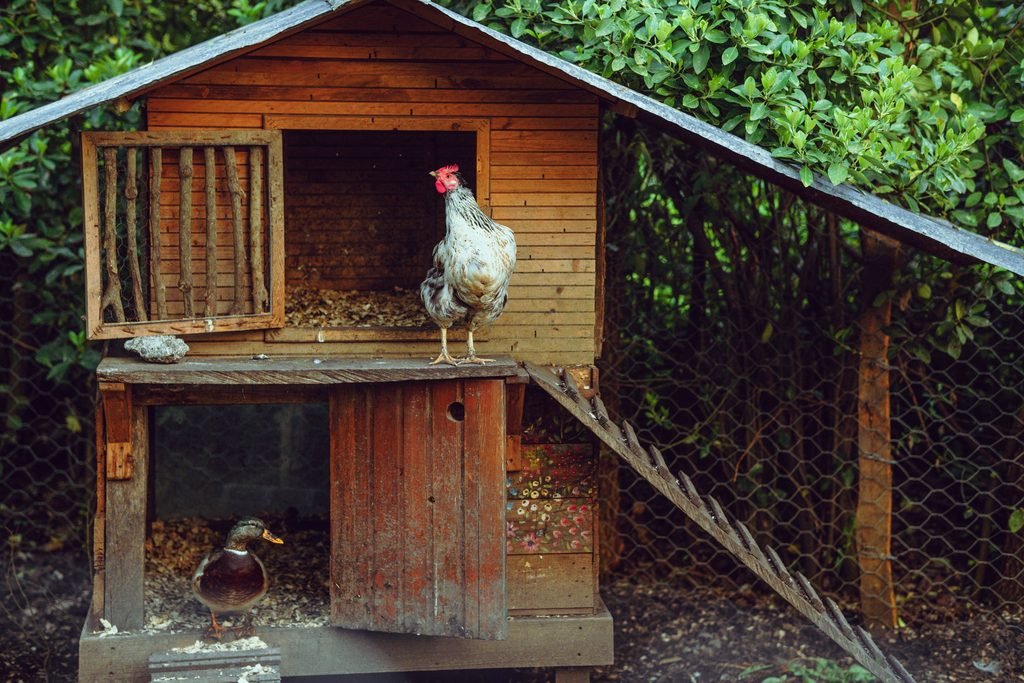
A rooster crowing inside a substantial enclosure may be less noticeable outside than the same rooster crowing in the open. Solid walls, a properly fitted door, suitable roof construction, and control of unnecessary gaps can reduce some sound transmission.
However, an ordinary chicken coop is not a soundproof room. Sound can still pass through building materials and escape through ventilation openings, doors, windows, and gaps. Housing should therefore be designed for safe sound reduction rather than complete acoustic isolation.
Never Sacrifice Ventilation for Silence
One of the worst responses to rooster noise is sealing the coop. Poultry housing requires fresh-air exchange to control moisture, heat, carbon dioxide, ammonia, and other air-quality problems. Covering ventilation openings with blankets, foam, boards, or other materials can create unsuitable conditions.
Penn State Extension’s small-scale poultry housing guidance emphasizes the importance of ventilation and moisture control in poultry housing. If a coop can only prevent neighbor complaints when its necessary ventilation is blocked, the housing or location needs reconsideration.
Reduce Sound Without Blocking Airflow
Noise reduction and ventilation do not have to be treated as opposites. Improve the solid parts of the structure first. Secure loose panels, address unnecessary construction gaps, use appropriate wall assemblies, and consider where major openings face.
Ventilation paths require more caution. Any attempt to redirect airflow or create baffled paths must maintain adequate air movement and should not create areas that collect excessive dust or moisture. Our guide on soundproofing a rooster coop without blocking ventilation explains this balance in more detail.
Keep Early Crowing Inside When Conditions Allow
If a suitable coop reduces sound transmission, allowing the rooster to remain inside for a reasonable period during the earliest morning hours may reduce the impact of some predawn crowing. This does not stop him from crowing. It changes where some of the calls occur.
The strategy only makes sense when the coop remains spacious, ventilated, secure, clean, and at a suitable temperature while occupied. Hot weather requires particular caution. Never leave birds inside an overheating enclosure simply to postpone outdoor crowing.
Don’t Keep a Rooster Confined All Morning Just for Noise
Delayed release should not turn into excessive confinement. A spacious poultry house designed for extended occupancy is different from a small sleeping coop. The available space, flock size, ventilation, temperature, water, cleanliness, and normal behavior of the birds all matter.
There is no universal release time that is appropriate for every flock. Our guide on whether keeping a rooster in the coop longer reduces noise explains when this strategy may help and where its limitations begin.
Consider an Automatic Coop Door
An automatic door can make a consistent morning routine easier. If the coop provides useful sound reduction, delaying the opening until an appropriate time may keep some early crowing inside the structure rather than immediately releasing the rooster into an open run.
An automatic door is not a noise-control device by itself. It does not stop crowing, and the coop still requires ventilation while closed. Its value is primarily consistency and convenience.
Control Unnecessary Artificial Light
Artificial light can influence poultry activity and biological rhythms. Avoid unnecessarily illuminating the coop during the night. That does not mean complete darkness will stop a rooster from crowing.
Roosters have an internal circadian system that contributes to predawn crowing, so a bird can begin calling before sunrise even when his surroundings remain dark. Our article asking whether a dark coop can stop a rooster crowing early explains why darkness should not be treated as an off switch.
Investigate Unusual Nighttime Crowing
Some nighttime or predawn crowing is normal. A sudden change in the pattern is still worth observing. Artificial light, nearby animals, people, vehicles, other roosters, environmental changes, and disturbances can all influence activity.
Do not automatically assume that every nighttime crow means a predator is present. Instead, look for changes in the rooster’s environment and behavior. Our guide on why a rooster may crow at night covers the common possibilities.
Think Carefully Before Keeping Multiple Roosters
More roosters mean more potential sources of crowing. Social relationships also influence rooster vocal behavior. Research published in Scientific Reports found that social rank affected the order of predawn crowing, with dominant males generally initiating the sequence.
The Scientific Reports study on social rank and rooster crowing provides the experimental details.
This does not mean two roosters automatically produce twice as much crowing. It does mean that adding males can make neighbor-noise management more complicated.
Don’t Rely on Buying a Supposedly Quiet Breed
Breed choice may influence the type of rooster you keep, but there is no rooster breed that can be guaranteed not to disturb neighbors. Individual behavior varies. Bantams still crow. Silkies still crow. A bird described online as quiet may still be clearly audible to someone living nearby.
Our guide to quiet bantam rooster breeds and what to consider explains why breed reputation should not be confused with a guarantee of low noise.
Don’t Expect a Silkie to Solve the Problem
Silkies are frequently recommended online when people ask about quieter roosters. That recommendation needs context. There is no reliable Silkie-specific decibel figure that proves every Silkie rooster is quiet enough for close neighbors.
Individual Silkies can still crow repeatedly and be clearly audible. If you’re considering the breed specifically because of noise, read our guide on whether Silkie roosters are actually quiet before making the decision.
Use Existing Solid Barriers Wisely
A substantial building or continuous solid barrier between the coop and a neighboring home may reduce some direct sound transmission. Barrier effectiveness depends on its size, position, mass, and whether it interrupts the direct path between source and receiver.
The Federal Highway Administration’s noise-barrier guidance explains the general physical principles involved in outdoor barriers. These principles come from transportation-noise management, not rooster-specific testing, so they should be used as acoustic context rather than a promise of a particular reduction.
Don’t Expect a Hedge to Soundproof the Yard
Trees and shrubs are useful landscaping features, but ordinary vegetation should not be treated as a soundproof wall. A narrow hedge may provide visual separation while doing relatively little to solve a serious rooster-noise problem.
If the property already contains substantial vegetation, keep it for its other benefits. Just do not rely on a few shrubs to compensate for placing a rooster immediately beside a neighbor.
Reduce Rattles and Other Coop Noise
The rooster does not have to be the only source of unwanted sound. Loose metal panels, doors, feeders, roofing, and hardware can rattle when birds move or when wind reaches the structure.
Inspect the coop periodically and secure loose components. Reducing unnecessary mechanical noise will not stop crowing, but it prevents the housing itself from adding to the disturbance.
Keep the Coop Clean
Neighbor relationships are not only about sound. Poor manure management, flies, odors, spilled feed, rodents, and an untidy enclosure can turn a manageable rooster situation into a broader neighborhood dispute.
Keep bedding and manure appropriately managed. Store feed securely. Clean spilled feed and address water leaks promptly. A well-maintained coop reduces several avoidable sources of conflict at once.
Prevent Feed From Attracting Rodents
Spilled poultry feed can attract rodents and other unwanted animals. Use appropriate feed storage, clean spills, and avoid leaving unnecessary food scattered around the coop.
This matters for flock management, but it also matters for neighbors. A property that creates pest problems is more likely to generate complaints regardless of how carefully rooster noise is managed.
Control Flies Before They Become a Neighbor Problem
Moist manure, wet bedding, and spilled feed can contribute to fly problems. Good drainage and routine manure management are important parts of keeping the surrounding area sanitary. Fix leaking waterers and prevent chronically wet areas around the coop where practical.
Noise may be the most obvious rooster concern, but sanitation problems can be equally damaging to neighbor relationships.
Talk to Your Neighbors When Appropriate
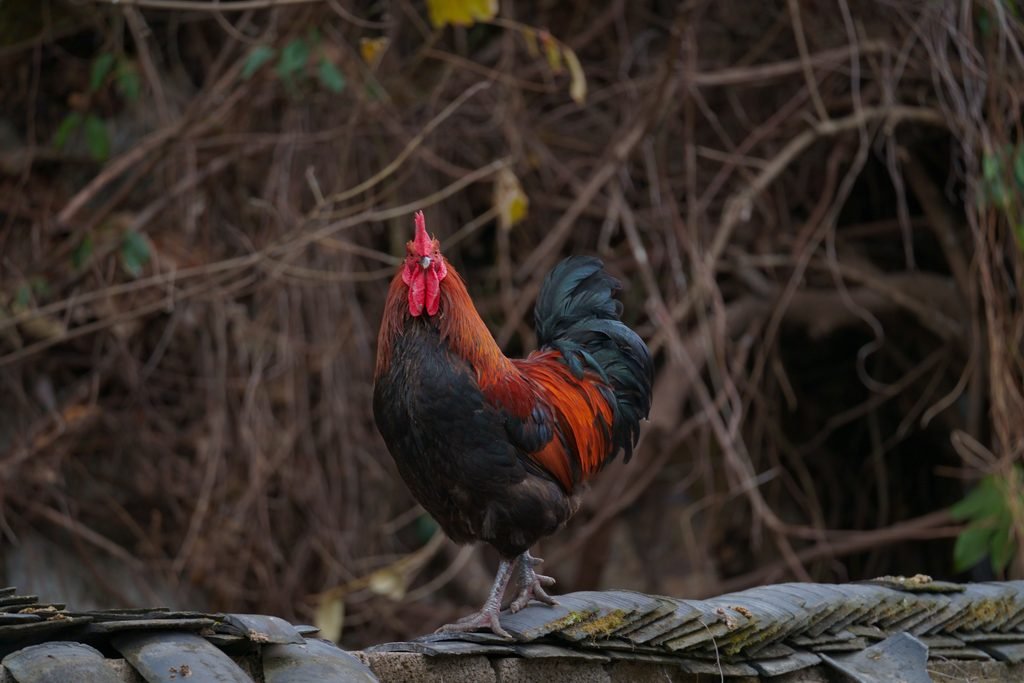
Communication can reveal problems before they become serious. A neighbor may have a bedroom directly facing the coop. Another may work night shifts and sleep during the day. These circumstances are not obvious from looking at the property boundary.
If rooster keeping is legal and communication with the neighbor is appropriate, being willing to listen to specific concerns can help identify practical changes.
A complaint such as “I hear him at 4:30 every morning through this bedroom window” is much more actionable than simply knowing someone dislikes rooster noise.
Respond to Specific Problems Rather Than Guessing
If a neighbor raises a concern, identify when and where the disturbance occurs. If the main problem is predawn crowing, morning housing may deserve attention. If the rooster is loud throughout the afternoon beside a patio, delaying morning release will not solve the real issue.
If sound is escaping through a large opening facing the neighboring house, orientation or building design may matter more than adding random acoustic materials. Target the actual sound path and time period.
Can Neighbors Hear a Rooster Inside the Coop?
Yes, they may still hear him. A substantial enclosure can reduce some sound transmission, but walls, doors, roofing, gaps, and necessary ventilation paths do not create complete isolation.
The closer the neighboring home is, the less realistic it becomes to expect an ordinary coop to make a rooster inaudible. See our guide on whether neighbors can hear a rooster inside a coop for a detailed explanation.
Be Careful With Acoustic Foam
Acoustic foam is commonly misunderstood. Materials designed to absorb reflections inside a room are not necessarily effective substitutes for the mass and construction needed to reduce sound transmission through a wall.
Any acoustic material used around poultry must also be appropriate for the environment and protected from pecking, moisture, dirt, and damage. Do not cover required ventilation openings with foam.
Avoid Extreme Confinement as a Noise Solution
A rooster should not be kept in an extremely small enclosure simply to interfere with his ability to crow or to contain the sound. Housing must provide suitable space, ventilation, temperature control, cleanliness, and access to necessities appropriate to the management system.
If controlling the noise requires keeping the bird in unsuitable conditions, the strategy is not appropriate. Consider whether the property itself is suitable for a rooster instead.
Be Cautious With Devices Intended to Restrict Crowing
Products placed directly on a rooster to restrict vocalization introduce different considerations from changing the environment around him. Any device fitted around the neck requires particular caution because poor fit, entanglement, breathing interference, injury, or other welfare problems can occur.
Environmental strategies such as legal placement, distance, housing, barriers, and sensible morning management are better starting points.
Don’t Wait for Multiple Complaints
If someone tells you the rooster is repeatedly waking them, investigate the problem while it is still manageable. Check the timing. Stand at different points around the property during the relevant period where doing so is practical. Look for obvious direct sound paths.
Determine whether a reasonable change in location, housing, orientation, or morning routine could reduce the impact. Ignoring a recurring problem rarely makes neighbor relations easier.
Know When the Property May Not Be Suitable
Some properties simply provide too little separation from neighboring homes for a rooster to be kept without substantial conflict. This is particularly possible on dense residential lots where bedrooms surround the yard on several sides.
No amount of wishful thinking changes the fact that a rooster is a naturally vocal animal. If normal crowing remains seriously disruptive despite reasonable legal housing and management, keeping that particular rooster at that location may not be practical.
A Practical Neighbor-Friendly Rooster Routine
Begin with secure, appropriately sized overnight housing that has adequate ventilation. Avoid unnecessary artificial light overnight. Check for repeated disturbances if the rooster suddenly becomes unusually active.
If conditions remain suitable and the coop provides meaningful sound reduction, use a reasonable and consistent morning release routine rather than automatically opening the main door at the first hint of predawn activity.
During the day, provide appropriate normal housing and management. Keep the coop and surrounding area clean, control spilled feed, maintain equipment, and monitor the rooster’s behavior.
Review the arrangement if the season changes. A morning routine that works during cool weather may be inappropriate during summer heat.
Frequently Asked Questions
How do you keep a rooster without upsetting neighbors?
Start by confirming that roosters are legal, then maximize practical distance from nearby bedrooms, use suitable housing, maintain ventilation, reduce unnecessary early-morning sound, keep the property clean, and respond constructively to specific concerns.
Can you train a rooster not to crow?
You should not expect to train normal crowing out of a rooster. Crowing is natural behavior influenced by circadian timing, social conditions, environmental cues, and individual behavior.
Will keeping a rooster in the coop until later stop complaints?
It may reduce some early-morning disturbance if the coop attenuates sound, but it does not stop the rooster from crowing. The enclosure must remain suitable for the birds during the additional time inside.
How far should a rooster be from a neighbor’s house?
There is no universal noise-safe distance. Follow local setback requirements first, then maximize practical separation from nearby bedrooms among the legal and otherwise suitable coop locations available.
Will soundproofing stop neighbors hearing a rooster?
Safe sound reduction can help, but an ordinary ventilated coop should not be expected to make a rooster completely inaudible. Distance, construction, openings, barriers, and the surrounding environment all matter.
Are some roosters quiet enough for close neighbors?
Individual roosters vary, but no breed should be guaranteed quiet enough for close neighbors. Even smaller or relatively less vocal birds still crow.
Final Thoughts
Learning how to keep a rooster without annoying your neighbors is less about finding one trick and more about managing several factors together. Start with legality, then consider distance, coop location, housing, ventilation, barriers, early-morning management, sanitation, and communication.
Do not promise silence. A rooster may still be heard from neighboring properties even when you manage him carefully. The objective is to reduce avoidable disturbance while maintaining appropriate conditions for the bird.
The best time to solve a neighbor-noise problem is before the coop is built. Choose the location carefully, plan for predawn crowing, and maintain realistic expectations. If the property cannot accommodate normal rooster behavior without repeated conflict, no soundproofing shortcut can fully solve that underlying limitation.