Why does my rooster crow at night? Roosters are strongly associated with sunrise, but their crowing is not restricted to the morning. A rooster may crow during the night in response to artificial light, sounds, activity around the coop, other roosters, or other environmental stimuli. In some cases, what seems like nighttime crowing is actually normal predawn crowing driven partly by the rooster’s internal biological clock.
An occasional nighttime crow is therefore not automatically unusual. The timing, frequency, surroundings, and any recent change in behavior can provide useful clues about why it is happening.
Why Do Roosters Crow at Night?
Rooster crowing is influenced by both internal biological rhythms and external stimuli. Although the most familiar crowing period occurs around dawn, roosters are capable of vocalizing at other times.
Scientific research published in Current Biology demonstrated that a rooster’s internal circadian clock plays an important role in predawn crowing. The researchers also examined the effects of external stimuli on crowing. The study is indexed by PubMed.
This helps explain an important distinction: some crowing heard during dark hours belongs to the rooster’s normal predawn rhythm, while other calls may occur in response to something happening in his environment.
1. Your Rooster May Be Anticipating Dawn
Before assuming something is disturbing the flock, consider what time the crowing occurs. A rooster that consistently starts calling in the hours before sunrise may simply be displaying normal predawn behavior.
Roosters do not need to see the sun before they begin crowing. Their internal circadian clock allows them to anticipate the beginning of the day.
Controlled experiments have demonstrated anticipatory predawn crowing even under constant dim-light conditions. If your bird routinely begins calling while the surroundings still look completely dark, our guide to whether roosters crow when it is still dark explains this biological rhythm in greater detail.
2. Artificial Light May Affect Nighttime Activity
Artificial lighting can change the nighttime environment around a rooster. Security lights, streetlights, vehicle headlights, porch lights, coop lighting, and lights from nearby buildings can expose birds to illumination that would not occur naturally at night.
Light is an important environmental cue for birds, although it should not be treated as the sole explanation for crowing. The circadian research on roosters demonstrates that external light and the internal biological clock interact rather than morning crowing being a simple reaction to sunrise.
If nighttime crowing recently appeared, checking whether a new or brighter light source is reaching the roosting area is a sensible part of investigating the environment.
3. Sounds or Activity Can Disturb the Rooster
A rooster does not become completely unresponsive after dark. Activity around the coop may disturb resting birds, and an awakened rooster can vocalize.
Possible disturbances vary considerably between properties. Vehicle movement, people approaching the coop, doors opening, equipment operating, dogs moving nearby, or sudden noises can all change an otherwise quiet nighttime environment.
Rather than assuming a particular sound is responsible, look for a repeatable pattern. If crowing consistently follows a specific nighttime event, that association provides more useful information than the crowing alone.
4. Other Roosters May Trigger a Response
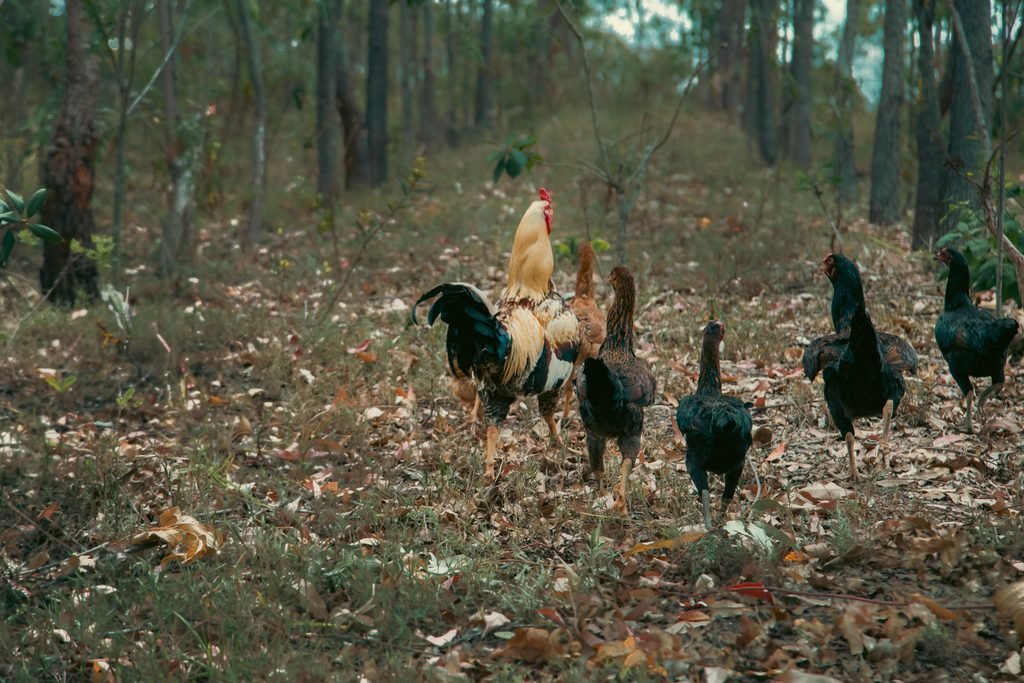
Roosters pay attention to the vocal behavior of other males. A rooster within hearing distance may therefore contribute to a sequence in which several birds call around the same period.
Rooster crowing also has an important social component. Research published in Scientific Reports found that social rank affected the order of predawn crowing in groups of roosters. Dominant birds generally initiated the sequence, followed by subordinate birds according to rank. The research is available through PubMed Central.
Although those findings concern predawn social behavior rather than every instance of nighttime crowing, they demonstrate that crowing is influenced by interactions between roosters and is not purely an isolated response to daylight.
5. Animals or Movement Around the Coop May Cause Disturbance
Wildlife, domestic animals, rodents, or other movement near the housing area can disturb a flock at night. However, crowing by itself should not be treated as proof that a predator is present.
If nighttime vocalization occurs alongside unusual agitation, repeated movement, or evidence that something has been interfering with the enclosure, inspect the housing and surrounding area carefully.
A secure coop is important regardless of whether a rooster is crowing. Doors, latches, wire, ventilation openings, and other potential entry points should be appropriate for the local risks facing the flock.
6. A Change in the Rooster’s Environment May Be Involved
Changes around the flock can alter normal routines. Moving birds to different housing, changing flock composition, introducing another rooster, modifying lighting, or creating new nighttime activity around the coop can coincide with changes in vocal behavior.
The timing of the change is useful. If a rooster that previously remained relatively quiet at a particular hour suddenly begins crowing after his surroundings have changed, examining the new conditions may reveal a likely trigger.
That does not mean every change will cause nighttime crowing. It simply provides a practical place to investigate when the behavior begins unexpectedly.
7. Your Rooster May Simply Be a Frequent Crower
Individual roosters vary considerably in vocal behavior. Some call much more frequently than others, and there is no universal daily crow count that defines every normal rooster.
A particularly vocal bird may therefore be more likely to be noticed outside the classic dawn period. Frequency also matters because repeated calls are much more noticeable at night when background noise is low.
Our guide explaining how often roosters crow examines individual variation, social hierarchy, time of day, and other factors affecting crowing frequency.
Is It Normal for a Rooster to Crow in the Middle of the Night?
Occasional crowing outside the morning period can occur. However, it is useful to distinguish a rooster calling occasionally during the night from one beginning his regular predawn crowing sequence.
Clock time alone can sometimes be misleading. Sunrise changes with season and location, and a rooster’s anticipatory crowing can begin before visible daylight.
If the bird starts at roughly the same early-morning time on a regular basis, the behavior may be associated more closely with his circadian rhythm than with a random nighttime disturbance.
Why Does My Rooster Crow at 2 AM?
A rooster crowing at 2 AM could be responding to an external stimulus, but the time alone does not identify the cause. Light, noise, another rooster, or activity around the coop are possibilities worth checking.
It is better to look for patterns than to assign a specific meaning to a particular clock time. Does the crowing happen every night? Does a security light switch on beforehand? Do nearby roosters call first? Is there movement around the housing?
Those observations can help distinguish a recurring environmental trigger from occasional vocalization.
Why Does My Rooster Crow at 3 AM?
The same principle applies to 3 AM. Depending on season and location, the bird could be several hours from sunrise, or he could be approaching his normal predawn period.
There is no universal clock time at which nighttime crowing becomes morning crowing. A rooster’s internal rhythm is not simply a reaction to the number displayed on a clock.
Regular early crowing is covered more closely in our article explaining why a rooster may crow at 4 AM.
Why Does My Rooster Suddenly Crow at Night?
If a rooster has recently started crowing at night after previously being quiet, consider what else has changed. New lighting, nearby animals, construction, traffic patterns, housing changes, or changes within the flock may all be worth investigating.
Observe the bird during the day as well. A change in crowing is more informative when considered alongside his general behavior rather than in isolation.
If an abrupt behavioral change occurs together with signs of illness, injury, breathing difficulty, weakness, reduced appetite, or other concerning symptoms, appropriate veterinary advice is more useful than assuming the problem is simply behavioral.
Does a Rooster Crow at Night Because He Sees Light?
Light may influence behavior, but seeing light is not required for a rooster to crow. This is particularly important when trying to explain early-morning calls.
Research has demonstrated that roosters retain rhythmic predawn crowing under controlled dim-light conditions. Their internal circadian clock therefore plays a major role even without a normal sunrise.
Artificial light is best considered one possible environmental influence rather than a universal explanation for every nighttime crow.
Does Covering the Coop Stop Night Crowing?
Making a rooster’s environment darker does not guarantee silence. Because the circadian system can produce predawn crowing without visible sunrise, simply blocking morning light cannot eliminate the underlying biological rhythm.
Reducing unnecessary artificial light may be reasonable when nighttime illumination is reaching the birds, but darkness should not be expected to prevent all crowing.
Any attempt to modify housing must also preserve adequate ventilation and safe temperatures. Noise reduction should never come at the expense of the birds’ basic housing needs.
Can You Stop a Rooster From Crowing at Night?
The most useful approach is to identify avoidable environmental triggers rather than expecting complete silence from an animal whose natural behavior includes crowing.
If a light repeatedly illuminates the coop, unnecessary nighttime illumination may be reduced. If a predictable disturbance wakes the flock, changing that disturbance may help. Housing should also be checked for signs of unwanted animal activity and basic security problems.
These measures may reduce particular triggers, but they cannot guarantee that a rooster will never vocalize at night or before sunrise.
Why Does Nighttime Crowing Seem So Loud?
A rooster may seem dramatically louder at night even if the physical characteristics of his crow have not changed. One major reason is the quieter background environment.
With less traffic, machinery, conversation, and general daytime activity, individual animal sounds can become much more noticeable. Repeated crowing can therefore carry greater practical impact during nighttime and early-morning hours.
Body size does not provide a simple solution either. Our guide examining whether bantam roosters crow loudly explains why smaller roosters should not automatically be assumed to create insignificant noise.
Should You Be Concerned About Nighttime Crowing?
Nighttime crowing by itself does not establish that something is wrong. An occasional call may occur in response to the environment, while regular calls close to dawn may form part of normal circadian behavior.
A sudden change deserves more attention when it occurs alongside other changes in the rooster’s condition or behavior. Likewise, repeated nighttime disturbance around the coop is worth investigating for practical flock-security reasons.
The goal is not to interpret every crow as an alarm. Instead, consider timing, repetition, environmental conditions, and the bird’s overall behavior together.
Frequently Asked Questions
Why does my rooster crow at night for no apparent reason?
If you are wondering why does my rooster crow at night when nothing obvious is happening, there may still be an environmental stimulus you have not noticed, or the call may simply occur as part of the bird’s vocal behavior. If it happens close to dawn, his internal circadian rhythm may also be involved.
Is nighttime crowing normal?
Roosters can vocalize outside daylight hours. Occasional nighttime crowing can occur, while regular predawn crowing is a well-documented part of rooster circadian behavior.
Does crowing at night mean a predator is nearby?
Not necessarily. Animals or movement can disturb a flock, but crowing alone is not reliable evidence that a predator is present. Inspect the enclosure if there are additional signs of disturbance.
Can streetlights cause a rooster to crow?
Artificial lighting can influence the nighttime environment and may act as a stimulus, but it is not required for crowing. Roosters can produce predawn crows under dim conditions because their internal biological clock also regulates the behavior.
Why does my rooster crow at the same time every night?
A consistent pattern may indicate a recurring environmental event or, particularly during the hours approaching dawn, an internally regulated daily rhythm. Comparing the crowing time with sunrise and events around the coop can provide useful clues.
Will keeping my rooster completely dark stop him crowing?
Not reliably. Scientific research demonstrates that roosters can maintain anticipatory predawn crowing under constant dim-light conditions, so visible sunrise is not required for the behavior.
Final Thoughts on Roosters Crowing at Night
Why does my rooster crow at night? There is no single explanation that applies to every bird. Artificial light, environmental disturbances, other roosters, activity around the coop, and individual vocal behavior can all play a role. Calls during the hours approaching sunrise may instead be part of the rooster’s normal circadian predawn behavior.
The most useful clues come from patterns. Note when the crowing occurs, whether anything happens immediately beforehand, whether other birds respond, and whether the behavior represents a change from the rooster’s usual routine.
Nighttime crowing therefore should not automatically be treated as either abnormal behavior or a warning signal. Understanding the timing and surrounding conditions makes it much easier to distinguish normal rooster vocalization from an avoidable nighttime disturbance.