How far should a rooster coop be from neighbors? There is no universal distance that works for every property. Local laws may impose specific setbacks, while the distance needed to reduce noise depends on the rooster, coop construction, surrounding barriers, terrain, and the location of nearby homes.
As a practical rule, provide as much reasonable separation from neighboring bedrooms and living areas as your legal and suitable coop locations allow. But distance should not be considered alone. A badly positioned coop at the far end of your yard could actually place the rooster closer to your neighbor.
There Is No Universal Rooster Coop Setback
It would be convenient to recommend one number, but doing so would be misleading.
Rules for keeping poultry are usually determined locally. A municipality may regulate coop setbacks, property boundaries, distances from residences, flock size, sanitation, nuisance noise, or whether roosters are permitted at all.
A legal distance in one location may therefore be prohibited in another. Before building or relocating a permanent coop, check the current rules for the exact property. Local regulations should take priority over a generic distance found online.
Legal Distance and Noise Distance Are Different
A legal setback tells you where a coop is permitted. It does not necessarily tell you where the rooster will be quiet enough to avoid disturbing someone.
A coop might satisfy a required setback while still being close to a neighboring bedroom. Conversely, a property may provide substantially more separation than the minimum required.
Think of these as two separate questions: where are you legally allowed to place the coop, and which of those legal locations creates the least practical disturbance?
The best site needs to satisfy both considerations.
Why More Distance Usually Helps With Rooster Noise
Sound generally becomes less intense as distance from its source increases. That makes separation one of the simplest tools available for managing rooster noise.
However, outdoor sound does not travel through a perfectly controlled environment. Buildings, barriers, ground conditions, weather, terrain, and background noise can all affect what reaches the listener.
The Federal Highway Administration’s environmental noise guidance explains the broader acoustic principles of distance and barriers in outdoor noise control. The source is transportation noise rather than poultry, but the physical principle is relevant: distance and the path between source and receiver both matters.
Don’t Measure Only From Your Own House
One of the easiest mistakes is putting the coop as far from your house as possible.
Imagine a suburban yard where the back boundary is far from your bedroom but directly beside the neighbor’s home. Moving the rooster to that boundary solves your distance problem by creating one for someone else.
Instead, look at all surrounding residences before choosing the site. The nearest noise-sensitive location may be a neighboring bedroom rather than your own house.
Bedrooms Matter More Than Property Lines for Noise
Property boundaries matter legally, but they do not tell you where people actually sleep. A neighbor’s house might sit close to the boundary, or it could be positioned much farther away. Bedroom windows may also face directly toward the proposed coop.
For practical noise management, consider both the legal boundary and the actual distance between the rooster and nearby sleeping areas. This is especially important because roosters commonly begin crowing before or around dawn.
Why Early-Morning Distance Matters
A rooster may be more disruptive at 4 or 5 AM than during the afternoon, even when the listener is the same distance away. Many people are sleeping during the predawn period. The surrounding environment may also contain less traffic, machinery, conversation, and other background noise.
That can make individual crows more noticeable. Our guide on why roosters crow at 4 AM and before sunrise explains why predawn calling is normal rooster behavior rather than something location alone can eliminate.
Is 50 Feet From a Neighbor Enough?
There is no basis for promising that 50 feet will prevent a neighbor from hearing a rooster. At relatively short distances, it is sensible to assume that crowing may remain noticeable, particularly outdoors or through an open window during quiet morning conditions.
Whether 50 feet is legally permitted is a separate question determined by local rules. Do not use 50 feet as a universal rooster-noise threshold.
Is 100 Feet From a Neighbor Enough?
One hundred feet provides more separation than 50 feet, but it still does not guarantee that a rooster will be inaudible. Coop construction, major openings, barriers, the individual bird, surrounding buildings, and background noise can all change what reaches the neighboring property. If a bedroom is roughly 100 feet from a rooster, plan on the possibility that crowing could still be heard. Distance reduces the problem; it does not create an acoustic wall.
What About 200 or 300 Feet?
Increasing separation can continue to reduce the sound reaching a listener, but 200 or 300 feet should not be presented as a guaranteed neighbor-safe distance either. A rooster crowing outdoors across quiet open land may remain audible at substantial distances.
A rooster inside a solid coop with a substantial building between him and the listener presents a different acoustic situation. This is why distance figures need context.
What About 500 Feet?
Even 500 feet does not guarantee silence. Rooster crowing can remain audible over considerable distances under suitable conditions. Quiet rural surroundings can make distant animal sounds particularly easy to recognize.
Our guide on how far away you can hear a rooster crow explains why there is no scientifically established maximum hearing distance. The practical objective is reducing disturbance, not reaching a magic number at which sound suddenly disappears.
Does the Coop Reduce the Distance Crowing Travels?
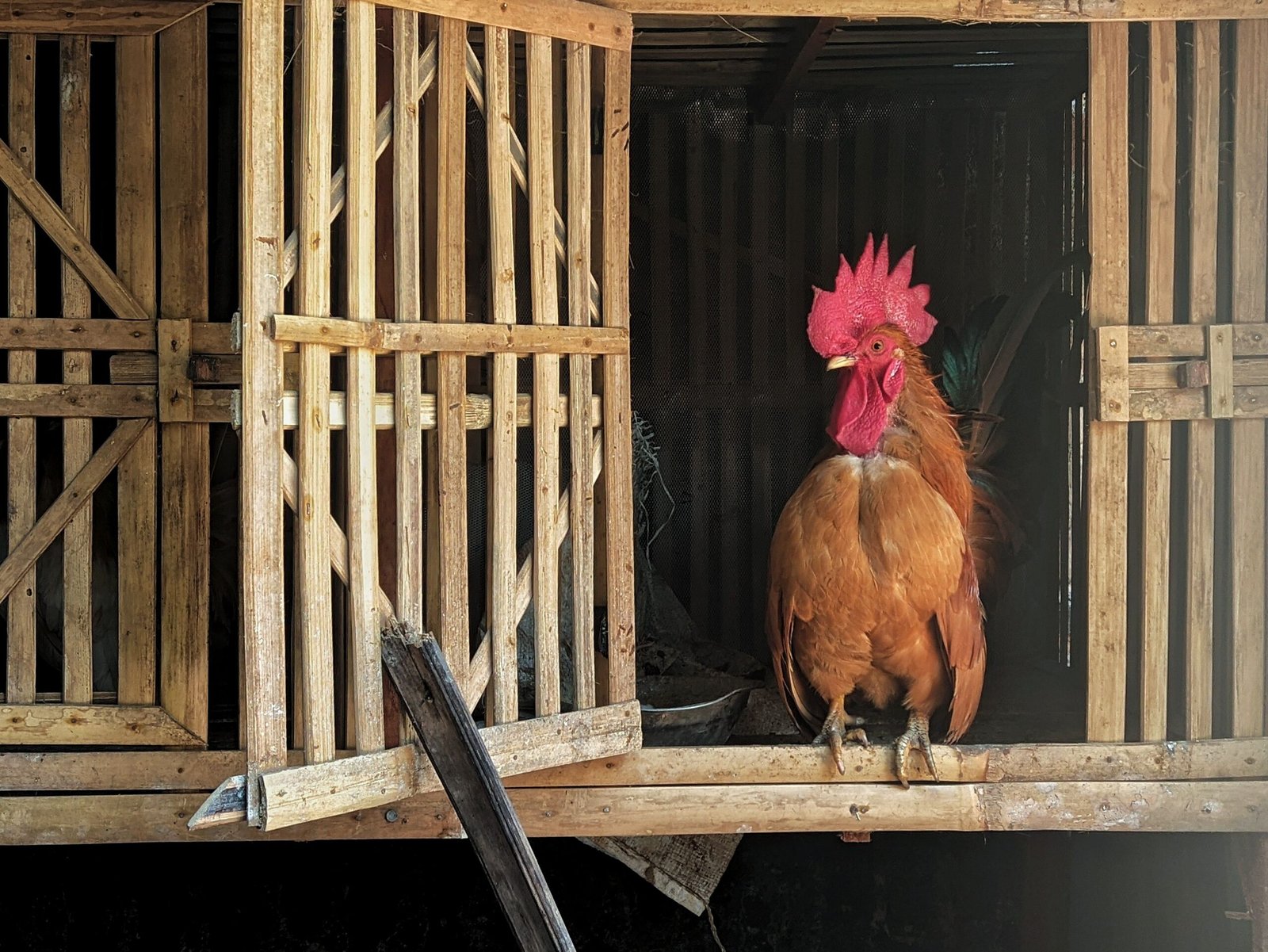
A substantial enclosed coop can reduce some sound transmission compared with a rooster crowing outside. The result depends on its walls, roof, doors, gaps, windows, and ventilation openings. A lightweight or largely open structure may provide relatively little isolation.
A better-built enclosure may reduce how noticeable the rooster is at a neighboring home, but it should not be expected to contain every crow. Any sound-control improvements also need to preserve safe ventilation.
Can Neighbors Still Hear a Rooster Inside the Coop?
Yes. An enclosed coop may make the crow less noticeable outside, but neighbors can still hear it. Sound can pass through building materials and escape through doors, gaps, and ventilation openings.
The closer the neighbor is, the harder it becomes to rely on the building alone. Our article on whether neighbors can hear a rooster inside a coop examines these sound paths in detail.
Does the Direction of the Coop Matter?
Yes, particularly when considering major openings. A large doorway or ventilation opening facing directly toward a neighboring bedroom creates a different sound path from one oriented toward a less sensitive area.
That does not mean rooster noise travels only in the direction the coop faces. Sound can pass through other parts of the structure and travel around obstacles. Orientation is simply another factor to consider alongside distance.
Can a Fence Reduce the Noise Reaching Neighbors?
A substantial solid barrier may reduce some outdoor noise when it interrupts the direct path between the source and receiver.
Its effectiveness depends on height, length, mass, gaps, and placement. A wire fence provides little physical obstruction to airborne sound. A solid fence should still not be treated as a guarantee that a nearby rooster will become inaudible.
It can support a good placement strategy, but it cannot replace adequate separation.
Can a Shed or Garage Help?
A substantial building between the rooster and a neighboring home may interrupt the direct sound path.
This can make an existing shed or garage useful when evaluating possible coop locations. However, do not squeeze the coop into an unsuitable space simply to place another structure in front of it. Poultry housing still needs ventilation, drainage, weather protection, access, and predator security. Local building and fire requirements may also restrict where structures can be positioned.
Do Trees and Hedges Create Enough Separation?
Ordinary landscaping should not be treated as a substitute for physical distance. Dense vegetation across substantial depth can affect sound propagation, but a thin hedge or row of shrubs does not provide the same barrier as a substantial solid structure.
Hedges can still improve visual screening and property layout. They simply should not be used to justify placing a noisy rooster very close to a neighboring bedroom.
Does Terrain Change the Best Distance?
Terrain can alter the sound path between the coop and neighboring properties. Hills, depressions, ridges, and other landforms may block or change direct propagation. An exposed elevated location can behave differently from a protected site surrounded by substantial terrain or structures.
There is no universal rule that a rooster coop should always be uphill or downhill from a neighbor. Evaluate the actual property instead.
Should You Put the Coop at the Back of the Property?
Only if the back of the property is genuinely a suitable location. Check what exists beyond the boundary. A neighboring house may be much closer to that corner than your own home.
Also consider drainage, sunlight, shade, prevailing weather, ventilation, security, and daily access. Our complete guide on where to put a rooster coop to reduce noise covers these location factors together.
Should the Coop Be Farther Away If You Have Several Roosters?
Several roosters create multiple potential sources of crowing. They can also respond to one another, and social rank influences crowing behavior. This does not mean two roosters automatically create exactly twice the noise.
It does mean that keeping several males can create more opportunities for crowing to affect surrounding properties. Greater separation from noise-sensitive areas becomes particularly valuable when several vocal birds are kept together.
Does Rooster Breed Change the Required Distance?
There is no scientifically established neighbor setback for individual rooster breeds. Some birds may have different vocal characteristics, but individual variation matters and even small roosters can produce conspicuous calls.
A Silkie or bantam should therefore not be used as justification for placing a coop unusually close to a neighbor. Housing and placement should assume that a rooster can be clearly audible rather than relying on a breed being advertised as quiet.
Can Soundproofing Let You Put the Coop Closer?
Sound-reduction measures may reduce the amount of crowing leaving the enclosure, but they do not override local setback requirements. Nor should soundproofing be used to justify an obviously poor location when a better legal site is available.
Safe acoustic improvements can include more substantial construction, better control of unnecessary gaps, appropriate wall assemblies, and careful treatment of sound paths. Our guide on how to soundproof a rooster coop safely covers those options without recommending an airtight enclosure.
Why You Should Never Block Ventilation to Satisfy a Neighbor
Noise concerns do not remove the rooster’s need for suitable housing. Poultry housing requires fresh-air exchange to manage moisture, heat, and air contaminants. Blocking vents to prevent a nearby neighbor from hearing crowing can create unsafe conditions inside the enclosure.
University of Minnesota Extension’s poultry housing guidance emphasizes ventilation as a fundamental part of appropriate poultry housing. If adequate ventilation makes a rooster too audible at a particular location, reconsider the location rather than sacrificing airflow.
Can Keeping the Rooster Inside Longer Help?
If a substantial coop reduces sound transmission, keeping the rooster inside for a reasonable period during the earliest morning hours may reduce how much of that crowing reaches neighboring properties.
It does not stop the rooster from crowing.
The coop must also remain suitable while occupied, with adequate ventilation, space, appropriate temperatures, and normal husbandry. See our guide on whether keeping a rooster in the coop longer reduces noise before using delayed release as part of a neighbor-noise strategy.
How Close Is Too Close to a Neighbor?
There is no universal number that defines “too close.” A location is clearly problematic if it violates local rules. Beyond that, proximity becomes a practical question involving the rooster’s noise, the location of nearby bedrooms, coop construction, barriers, background noise, and the neighbor’s actual exposure.
If normal predawn crowing is clearly disruptive even after reasonable housing and management measures, the property may not provide enough separation for that rooster. That possibility should be considered before increasingly restrictive attempts to suppress the bird’s natural behavior.
What If You Live on a Small Suburban Lot?
Small lots make rooster placement particularly difficult because there may be no location that provides substantial separation from every surrounding home. Check local rules before acquiring a rooster. Some jurisdictions restrict or prohibit roosters in dense residential areas.
If roosters are permitted, compare every suitable coop location rather than automatically choosing a property boundary. On a very small lot, good placement and housing may reduce disturbance but cannot guarantee that nearby residents will not hear crowing.
What If You Have a Large Rural Property?
A larger property provides more opportunities to increase separation from residences. However, quiet rural environments can also allow distinctive animal sounds to remain noticeable across substantial distances.
Use the available space intelligently. Consider nearby residences, terrain, existing buildings, access, drainage, and utilities rather than simply placing the coop at an arbitrary distant point. The goal is practical separation combined with appropriate animal housing.
How to Choose the Best Distance on Your Property
Start with local regulations. Identify every part of the property where a rooster coop is legally permitted. Next, eliminate locations that are unsuitable because of drainage, heat exposure, inadequate ventilation, poor access, or security problems.
Compare the remaining sites with nearby bedrooms and residences. Consider distance, major coop openings, terrain, existing buildings, and substantial barriers.
If two locations are otherwise equally suitable, the one providing greater practical separation from noise-sensitive areas will usually be preferable for rooster-noise management.
Talk to Neighbors Before Noise Becomes a Problem
Where appropriate, communication can reveal information that a property map cannot. A neighboring bedroom may be on the side of the house closest to the proposed coop. Someone may work night shifts and sleep during hours when daytime crowing is particularly disruptive.
This does not replace compliance with local rules, but understanding the surrounding households can help avoid an obviously poor placement decision. It is much easier to consider these issues before constructing a permanent coop than after repeated complaints begin.
Frequently Asked Questions
How far should a rooster coop be from neighbors to reduce noise?
How far should a rooster coop be from neighbors depends on local regulations and the actual property. There is no universal noise-safe distance. Where several legal and suitable sites exist, maximize practical separation from neighboring bedrooms while considering barriers, orientation, drainage, ventilation, and access.
Is 100 feet far enough from a neighbor for a rooster?
One hundred feet does not guarantee that a neighbor will not hear crowing. Whether it is legally permitted also depends on local regulations.
Can neighbors hear a rooster from 500 feet away?
They potentially can. Rooster crowing can remain audible over substantial distances, particularly in quiet, open environments.
Should I put my rooster coop against the back fence?
Not automatically. Check what lies beyond the fence. A back-boundary location may put the rooster closer to a neighboring home even though it moves him farther from yours.
Does a solid fence mean the coop can be closer?
A substantial solid barrier may reduce some sound transmission, but it does not override legal setbacks or guarantee that a nearby rooster will be inaudible.
Can soundproofing replace distance from neighbors?
No. Sound reduction can complement good placement, but it cannot guarantee silence and does not override local rules. Distance, appropriate housing, orientation, and barriers should be considered together.
Final Thoughts
How far should a rooster coop be from neighbors? There is no single number that applies everywhere. Start with the setback and rooster-keeping rules for the specific property, then choose the legal location that provides the best practical separation from nearby bedrooms and living areas.
Do not rely on arbitrary distances such as 50, 100, or 500 feet as guarantees. Rooster crowing can remain audible across considerable distances, and property layout, barriers, housing, terrain, and background noise all affect what a neighbor hears.
The strongest approach combines legal compliance with sensible distance, thoughtful coop orientation, appropriate barriers, safe housing, and realistic expectations. If a property cannot provide enough separation for normal rooster crowing without creating recurring conflict, placement alone may not solve the underlying problem.