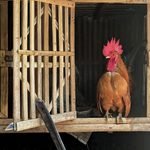
Learning how to soundproof a rooster coop safely requires balancing two very different goals: reducing the amount of crowing noise that reaches nearby people while maintaining a healthy environment for the rooster. A completely sealed enclosure may contain more sound, but it can also trap heat, moisture, ammonia, and stale air. That makes complete soundproofing the wrong objective for a living animal.
A safer approach is sound reduction. Thoughtful coop placement, solid construction, sound-absorbing materials in appropriate locations, controlled sound paths, and well-designed ventilation can reduce the impact of crowing without turning the coop into an airtight box.
Affiliate Disclosure: This article contains affiliate links. We may earn a commission from qualifying purchases at no additional cost to you.
Can You Really Soundproof a Rooster Coop?
You can reduce sound escaping from a rooster coop, but making a normal chicken coop completely soundproof is neither realistic nor desirable. Effective sound isolation usually involves controlling openings and using dense construction that resists sound transmission. A chicken coop, however, requires intentional openings for fresh-air exchange. Birds also need a suitable temperature and an environment that does not accumulate excessive moisture or irritating gases.
Penn State Extension’s guidance on small-scale poultry housing explains that ventilation brings fresh air into poultry housing while removing moisture, ammonia, carbon dioxide, and stale air.
For a rooster coop, ventilation therefore has to take priority over achieving maximum acoustic isolation.
Why Rooster Coop Soundproofing Can Be Dangerous
The biggest mistake is treating a rooster coop like a recording studio. A studio can be heavily sealed because mechanical ventilation and climate-control systems can be engineered separately. A simple backyard coop normally does not have those systems.
If vents are blocked and gaps are sealed indiscriminately, moisture and air contaminants can accumulate. Heat can also become a serious problem during warm weather.
The University of Minnesota Extension emphasizes the importance of ventilation in poultry housing and notes the need to remove moisture while avoiding drafts directly on the birds.
Any noise-reduction project should therefore begin with one rule: never sacrifice necessary airflow simply to make the coop quieter.
Soundproofing vs. Sound Absorption: What’s the Difference?
These terms are often used interchangeably, but they describe different jobs.
Sound isolation is about reducing how much sound travels from one space into another. Dense, well-constructed barriers generally perform this job better than lightweight materials.
Sound absorption is about reducing reflections within a space. Soft or porous acoustic materials can absorb some sound energy rather than reflecting it repeatedly from hard surfaces.
Putting lightweight foam on a wall therefore does not automatically make that wall an effective sound barrier. For a rooster coop, the construction of the walls and the paths through which sound escapes can matter considerably.
1. Start With the Location of the Coop
Before buying any sound-control material, consider where the coop sits on the property. Distance is one of the simplest tools available for reducing the impact of a noise source.
Where space and local regulations allow, avoid positioning the rooster’s sleeping area immediately beside bedrooms, neighboring houses, patios, or other noise-sensitive locations.
The direction of openings matters too. A large opening facing directly toward a neighboring bedroom creates a different sound path from an opening facing toward a less sensitive part of the property.
Always check local requirements before building or relocating a coop. Rules concerning roosters, setbacks, structures, animal numbers, and nuisance noise vary between jurisdictions.
2. Use Solid, Well-Built Walls
Lightweight, thin walls generally provide less resistance to sound transmission than heavier, more substantial construction. If a coop is being designed from the beginning, solid construction can therefore help reduce the amount of crowing that passes directly through the walls.
This does not mean making the structure airtight. The goal is to improve the solid portions of the enclosure while preserving deliberately designed ventilation.
Loose wall panels should also be secured properly. Apart from sound transmission, rattling panels can create additional noise when exposed to wind or movement.
3. Consider Adding Mass to the Wall Assembly
Increasing the mass of a wall can improve its resistance to airborne sound. In building acoustics, heavier wall assemblies generally provide greater sound isolation than very lightweight barriers, although actual performance depends on the complete construction.
The Whole Building Design Guide, a resource of the U.S. National Institute of Building Sciences, explains fundamental approaches to controlling airborne and structure-borne sound in buildings.
For a coop, additional layers of appropriate building material may be more useful for sound isolation than simply attaching thin acoustic foam to the interior.
Any added material must be installed securely and should not create surfaces the birds can easily tear apart or ingest.
4. Use Insulation Inside Enclosed Wall Cavities
Insulation within a properly constructed wall cavity can form part of a broader noise-reduction assembly. The important words are within a properly constructed wall.
Loose fibrous insulation should not be left exposed where chickens can peck, scratch, damage, or ingest it. Interior wall surfaces should protect any insulation from direct contact with the birds.
The choice of material should also consider moisture, fire safety, pests, cleaning, and the conditions inside a poultry building rather than sound performance alone.
5. Reduce Unnecessary Sound Leaks
Sound can travel through gaps around poorly fitted doors, wall joints, and other unintended openings. Improving construction around unnecessary gaps may help reduce sound leakage.
Small gaps around a coop door can allow sound and drafts to pass through. Where appropriate, self-adhesive pile brush weatherstripping may help reduce gaps around a properly fitted door frame. Choose a suitable size, install it away from areas birds can peck, and inspect it regularly for wear. Weatherstripping is not a substitute for acoustic insulation, and essential coop ventilation must remain unobstructed.
For larger gaps around a coop door, a different seal profile may be more suitable than brush weatherstripping. The VITAM AMO self-adhesive weather stripping seal is designed for gaps approximately 5/16 to 15/32 inch wide. Measure the gap before choosing a seal, and make sure the door still closes securely. Keep adhesive seals out of the birds’ reach and never use them to close essential ventilation openings.
However, an unintended gap and an intentional ventilation opening are not the same thing.
A crack around a badly fitted door can potentially be corrected. A vent required to exchange air should not simply be filled with sealant or covered with solid material.
This distinction is fundamental to how to soundproof a rooster coop safely: control unnecessary sound paths without eliminating the airflow the bird needs.
6. Never Block the Ventilation Openings
Ventilation is not an optional feature that can be removed whenever noise becomes inconvenient.
Poultry produce moisture through respiration and manure, while decomposition of waste can contribute to ammonia in the housing environment. Proper ventilation helps remove moisture, contaminants, and excess heat.
University of Georgia Extension’s poultry ventilation guidance discusses the role ventilation plays in controlling temperature, moisture, and air quality in poultry housing.
Do not cover vents with solid panels, blankets, foam, or other materials simply because crowing can escape through them.
7. Design Ventilation With Noise in Mind
Keeping vents open does not mean their placement has to be ignored when designing a coop.
When building from scratch, ventilation and noise management can be considered together. For example, an opening aimed directly toward a nearby bedroom may have a different practical effect from one positioned toward a less noise-sensitive direction.
More advanced acoustic ventilation designs sometimes use indirect airflow paths or baffling to reduce a direct line for sound transmission. However, any such design must still provide sufficient unrestricted airflow for the birds and be easy to clean.
If you are uncertain whether a modified ventilation system provides enough air exchange, prioritize established poultry-housing guidance or professional advice rather than guessing for the sake of noise reduction.
8. Be Careful With Acoustic Foam
Acoustic foam is often the first product people associate with soundproofing, but its purpose is commonly misunderstood.
Foam can absorb some reflected sound inside a room, but lightweight foam by itself is not a substitute for a substantial sound-isolating wall. It also creates practical problems in a chicken coop if birds can reach it.
A rooster may peck or damage exposed material, and porous surfaces can be difficult to keep clean in a dusty poultry environment.
If an acoustic product is used at all, it should be selected for the actual environment, installed safely out of the bird’s reach, and should never cover required ventilation.
9. Consider Internal Sound Absorption Carefully
Hard interior surfaces reflect sound. Adding suitable absorption in protected areas may reduce some of those reflections and make the interior less acoustically lively.
But sound absorption should be considered a supporting measure rather than the entire strategy. Absorbing reflections inside the coop is different from preventing sound from passing through a wall or an open vent.
Materials also need to withstand the realities of poultry housing. Dust, moisture, insects, cleaning, pecking, and fire safety all matter.
A product that works well in an office or recording room is not automatically appropriate inside an animal enclosure.
10. Pay Attention to the Coop Door
A lightweight or badly fitting door can become a significant weak point in an otherwise solid structure.
A more substantial, properly fitted door may reduce sound leakage through unnecessary gaps. Weatherstripping around appropriate door edges can sometimes help with uncontrolled openings as long as it does not interfere with intentional ventilation.
The door should still operate safely and provide practical access to the bird. Do not create a locking or sealing arrangement that makes emergency access difficult.
11. Consider Barriers Outside the Coop
Noise management does not have to happen entirely inside the enclosure. Depending on the property, solid barriers outside the coop may alter the direct path between the rooster and a nearby receiver.
Walls, fences, buildings, and terrain can influence how sound travels. The effectiveness of any barrier depends on its dimensions, construction, placement, and the positions of the sound source and listener.
Vegetation can be useful for landscaping and visual screening, but a few shrubs should not be marketed as reliable soundproofing.
Think of external barriers as one possible part of a larger strategy rather than a guaranteed cure for rooster noise.
12. Reduce Vibration and Rattling
Not every annoying sound coming from a coop is the rooster’s voice. Loose roofing, doors, wire panels, feeders, and other components can rattle when birds move or when wind reaches the structure.
Secure loose components and maintain the building so that the coop itself does not add unnecessary mechanical noise.
This will not make a rooster’s crow quieter at its source, but it can improve the overall noise environment and make the structure more durable.
13. Keep the Coop Dry and Maintainable
Noise-control materials should not make normal cleaning and moisture management significantly harder.
Poultry housing accumulates dust and organic material, so surfaces should be practical to inspect and maintain. Materials that readily absorb moisture or cannot be cleaned appropriately may create new problems even if they offer some acoustic benefit.
Design decisions should therefore consider durability, sanitation, moisture resistance, fire safety, and animal access alongside acoustic performance.
Will Insulating a Rooster Coop Reduce Crowing Noise?
Insulation can contribute to a better wall assembly, but insulation alone should not be treated as a complete soundproofing solution.
The amount of sound reduction depends on the entire construction: wall mass, cavities, gaps, doors, windows, vents, roof construction, and other transmission paths.
An insulated wall can still be undermined acoustically by a large open doorway or ventilation path. Conversely, those ventilation openings cannot simply be eliminated because the birds require fresh air.
Think in terms of improving the complete enclosure rather than searching for one miracle material.
Will a Dark Coop Also Reduce Rooster Noise?
Darkening a coop and reducing sound are different strategies. A darker sleeping area may reduce unnecessary artificial-light stimulation, but darkness cannot reliably stop normal predawn crowing.
Roosters possess an internal circadian rhythm that helps them anticipate dawn even without seeing sunrise.
Our guide asking whether a dark coop can stop early rooster crowing explains why blackout-style approaches should not be mistaken for dependable noise control.
Can You Make a Rooster Coop Completely Soundproof?
Attempting complete sound isolation creates an obvious conflict with ventilation. Openings that allow air exchange can also allow some sound to escape.
Professional acoustic spaces solve this problem with engineered ventilation and mechanical systems designed specifically for both airflow and noise control. That is far beyond what most backyard chicken coops contain.
For a normal rooster enclosure, the realistic objective is therefore to reduce sound transmission rather than promise complete soundproofing.
How Much Can Soundproofing Reduce a Rooster’s Crow?
There is no responsible universal number of decibels that can be promised for a DIY rooster coop.
Actual sound reduction depends on the original structure, construction materials, openings, ventilation, workmanship, distance, surrounding buildings, and where the sound is measured.
A claim that adding one particular material will always reduce rooster crowing by a specific number of decibels should be treated cautiously unless it is supported by testing of that exact assembly under defined conditions.
Rooster noise itself also varies. Our article on how often roosters crow explains why frequency and repetition can matter just as much as an individual call.
What About Soundproof Blankets?
Heavy acoustic blankets can reduce some sound transmission or reflections in appropriate applications, but simply wrapping a chicken coop in blankets is not a safe general solution.
Blankets can obstruct airflow, collect moisture and dust, create cleaning problems, and may pose risks if birds can reach or damage them.
Never hang a material over ventilation openings simply because it is marketed for sound control.
What About Mass-Loaded Vinyl?
Mass-loaded vinyl is a dense material used in some building-acoustic assemblies to add mass without requiring a very thick layer.
That does not mean it should be loosely hung inside a rooster enclosure. If such a building material is used, it should form part of an appropriately constructed wall system and remain protected from the birds.
Installation requirements, fire characteristics, moisture conditions, manufacturer instructions, and the complete wall design all matter.
No single product eliminates the need to address doors, vents, openings, and other sound paths.
Should You Soundproof the Roof?
The roof is another part of the building envelope through which sound can travel. A very lightweight roof may provide less acoustic isolation than a more substantial assembly.
However, roof modifications also affect heat, moisture, structural loads, and ventilation. Adding heavy materials to a structure not designed for them can create safety problems.
Any substantial modification should therefore be appropriate for the building’s structure and local weather conditions rather than being chosen solely for its acoustic properties.
Can Soundproofing Stop Early-Morning Crowing?
Soundproofing does not stop the rooster from crowing. It attempts to reduce how much of that sound reaches people outside the enclosure.
This distinction matters because early-morning crowing is partly regulated by an internal biological clock. Housing modifications do not remove the underlying behavior.
For strategies aimed at the environmental triggers rather than the sound itself, see our guide on how to reduce early-morning rooster crowing.
A Safer Rooster Coop Sound-Reduction Strategy
A practical approach begins before any acoustic material is purchased. First, identify who is being affected by the noise and which parts of the coop face those locations. Then inspect the enclosure for thin construction, poorly fitting doors, unnecessary gaps, and direct sound paths.
Improve solid sections of the building where appropriate, while identifying and protecting every opening needed for ventilation. Consider whether the coop’s location or orientation can be improved, and address rattling or unnecessary mechanical noise.
Only then should additional acoustic materials be considered. Any material added must be appropriate for an animal-housing environment, protected from pecking, compatible with cleaning and moisture control, and installed without compromising airflow or fire safety.
Soundproofing Mistakes to Avoid
Do not seal the coop airtight. Do not block ventilation with foam, blankets, boards, or insulation. Do not leave fibrous insulation or acoustic materials exposed where birds can peck them. Do not assume lightweight foam will stop sound passing through a wall.
Avoid adding heavy materials to walls or roofs without considering structural capacity. Avoid creating inaccessible cavities that become difficult to inspect for moisture or pests.
Most importantly, do not judge a modification only by whether the coop sounds quieter from outside. A quieter coop that has become hotter, more humid, poorly ventilated, or unsafe is not a successful design.
Frequently Asked Questions
How can I soundproof a rooster coop safely?
To understand how to soundproof a rooster coop safely, focus on sound reduction rather than creating an airtight enclosure. Use appropriate solid construction, address unnecessary gaps, consider protected absorption and external barriers, and maintain adequate ventilation at all times.
Can I put acoustic foam inside a chicken coop?
Exposed acoustic foam is generally a poor choice where chickens can peck or damage it, and foam alone does not provide complete sound isolation. Any acoustic material should be appropriate for the environment and protected from direct bird access.
Can I cover the vents to stop crowing noise?
No. Ventilation openings serve an important air-quality and temperature-control function. Do not block necessary ventilation simply to reduce sound.
Does insulation make a rooster coop quieter?
Insulation can contribute to the acoustic performance of a properly constructed wall assembly, but results depend on the entire structure. It is not a stand-alone guarantee of significant noise reduction.
Can I completely soundproof a rooster coop?
Complete soundproofing conflicts with the need for ventilation unless sophisticated engineered systems are used. For a normal backyard coop, reducing the impact of crowing is a more realistic and safer goal.
Will soundproofing stop my rooster from crowing?
No. Sound-control measures affect how noise travels; they do not remove the rooster’s natural motivation to crow. Roosters can continue crowing inside a quieter enclosure.
Final Thoughts on Soundproofing a Rooster Coop
Learning how to soundproof a rooster coop safely is really about intelligent sound reduction. Solid construction, appropriate wall assemblies, better control of unnecessary gaps, thoughtful coop placement, protected sound absorption, and external barriers may all contribute to a quieter result.
But ventilation remains non-negotiable. A rooster’s housing must continue to remove heat, moisture, ammonia, and stale air while providing suitable living conditions. Never block essential airflow simply to contain crowing.
The best rooster coop is therefore not the one that traps every possible sound. It is one that reduces unnecessary noise while remaining safe, ventilated, maintainable, and appropriate for the bird living inside it.