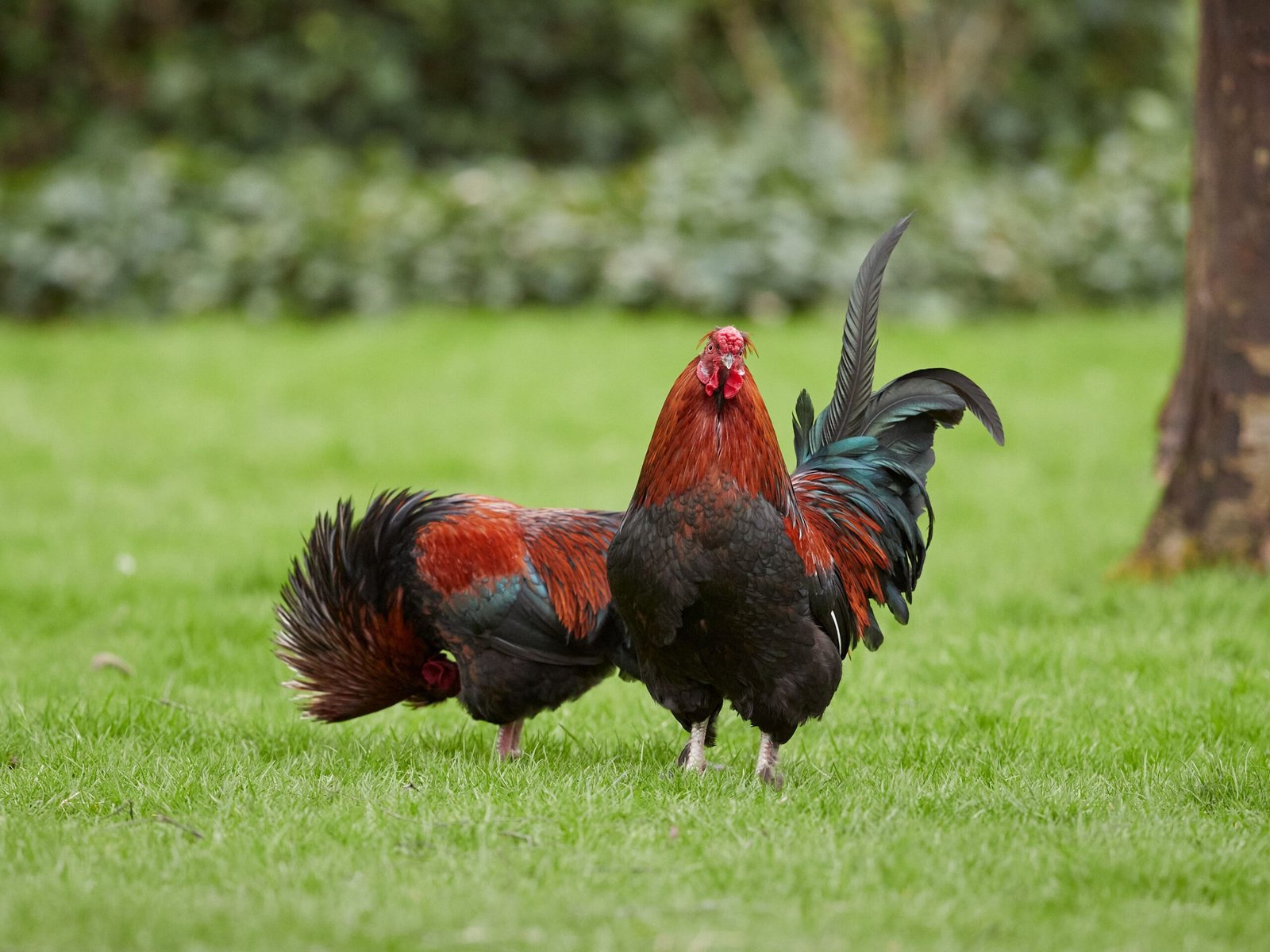
Can two roosters live together without hens? Yes, some pairs of roosters can live together successfully without females, particularly when they are compatible and have enough space and resources. Removing hens may remove one source of competition, but it does not guarantee that two males will get along.
Roosters still establish social relationships and dominance hierarchies when hens are absent. Age, temperament, previous experience, available space, introductions, and competition around food, water, and roosting areas can all affect whether two males coexist peacefully. Some pairs settle into a stable relationship, while others may eventually require permanent separation.
Two Roosters Can Live Together Without Hens
There is no biological requirement for every rooster to live with hens. Two males may share an enclosure without females, and larger male-only groups are sometimes described as bachelor flocks.
The important question is not simply whether hens are present. The birds need to establish a workable social relationship without one rooster being persistently attacked, excluded from resources, or forced to spend his time avoiding the other.
Domestic chickens have complex social behavior and can recognize relationships within their group. A detailed review of chicken cognition and social behavior published in Animal Cognition describes chickens as socially complex animals with sophisticated communication and social-learning abilities.
Will Two Roosters Fight If There Are No Hens?
They can. Removing hens does not remove the social hierarchy between male chickens. Roosters can still challenge one another, establish dominance, defend access to resources, and respond aggressively to another male.
Not every disagreement means that two roosters are incompatible. Chickens establish social rank, and some chasing, posturing, or brief confrontations may occur while the relationship is being established. The concern is persistent aggression that prevents one bird from eating, drinking, resting, moving normally, or using the enclosure safely.
A pair that repeatedly causes injuries or places one rooster under continual pressure should not be kept together simply because there are no hens involved.
Does Removing Hens Make Roosters Less Likely to Fight?
The absence of hens may reduce one potential source of competition, but it should not be treated as a reliable method for preventing aggression. Male chickens have social relationships with one another regardless of whether females are present.
Temperament, maturity, territory, space, and the existing hierarchy remain important. A pair of males that appears peaceful without hens can still experience conflict, particularly when circumstances change.
Removing hens may therefore change the social environment without eliminating the underlying possibility of competition between the two roosters.
Rooster Hierarchy Matters Even Without Hens
Roosters can establish clear dominance relationships. One male may occupy a higher social position while the other becomes subordinate, and that relationship can influence more than physical confrontations.
Research has demonstrated that social rank affects rooster crowing. In experiments published in Scientific Reports, the highest-ranking rooster generally initiated predawn crowing, while subordinate males followed according to the established social order.
The Scientific Reports study on social rank and rooster crowing provides useful evidence that male chicken behavior is strongly influenced by hierarchy rather than simply by the presence of hens.
A stable hierarchy can sometimes allow two males to coexist, but stability should not be confused with a situation in which one bird is continually harassed or unable to use essential resources.
Roosters Raised Together May Have an Advantage
Two males that have grown up together may already be familiar with one another when they reach maturity. That familiarity can make the social transition easier in some cases, although it does not guarantee lifelong compatibility.
Young cockerels that appeared inseparable can behave differently as they mature. Sexual maturity can bring changes in confidence, territorial behavior, crowing, and social competition, so a peaceful juvenile relationship should not be assumed to predict adult behavior perfectly.
Continue monitoring the birds as they mature rather than assuming that successful early housing has permanently settled the issue.
Can Two Adult Roosters Be Introduced?
Introducing two unfamiliar adult males requires more caution than simply placing them together and waiting for a hierarchy to form. An abrupt introduction can produce an immediate confrontation without giving either bird an opportunity to become familiar with the other.
A more controlled approach allows the roosters to see and hear one another through a secure barrier before unrestricted contact is attempted. This does not guarantee compatibility, but it allows you to observe their reactions while preventing immediate physical injury.
When direct contact is eventually allowed, the area should provide enough room for the birds to move apart. Supervise the early interactions closely and have a secure separation area ready in case aggression escalates.
Neutral Space Can Help During Introductions
Introducing a new rooster directly into an area strongly associated with another male may add territorial pressure to an already difficult social situation. Where practical, an unfamiliar or rearranged area can reduce some of that environmental advantage during the initial introduction.
Changing the environment does not erase the birds’ social behavior, however. They may still challenge one another and establish rank.
The objective is not to prevent every social interaction. It is to create enough room and supervision for the birds to interact without allowing persistent aggression or serious injury.
How Much Space Do Two Roosters Need?
There is no scientifically established square-foot requirement specifically for a pair of roosters. General poultry housing recommendations provide a starting point, but two males sharing an enclosure may need additional room because social distance is important as well as basic floor area.
A subordinate rooster should be able to move away from the dominant bird without becoming trapped against fencing, walls, feeders, or corners. Larger runs also provide more opportunities to create separate activity areas and distribute resources.
Our guide on how much space one rooster needs explains general coop and run allowances. When housing two males together, calculate adequate space for both birds and consider providing additional room rather than designing around the smallest possible allowance.
More Space Does Not Guarantee Peace
Providing a large enclosure can make social management easier, but space cannot make every pair compatible. Two highly antagonistic roosters may continue seeking each other out even when plenty of room is available.
This distinction matters because increasing the run size should not become an endless attempt to solve persistent aggression. If one rooster continually pursues and injures the other despite appropriate housing and management, separation may be the safer long-term solution.
Think of additional space as providing the birds with more options rather than as a guaranteed treatment for aggression.
Provide More Than One Resource Point
Two roosters sharing an enclosure should be able to access essential resources without one bird controlling everything. Providing more than one appropriately positioned feeding or watering point can be useful when social pressure develops around resources.
Placement matters as much as quantity. Two feeders positioned directly beside each other may function almost like a single resource if a dominant rooster can control the entire area. Separating resources gives the subordinate bird more opportunity to use them without approaching the dominant male.
Observe the birds during feeding rather than assuming that food is accessible simply because there is enough for both.
Roosting Arrangements Matter Too
Nighttime housing needs enough usable roosting space for both males. A subordinate rooster should not be repeatedly forced from the perch or trapped in an unsuitable sleeping position because the dominant bird controls the available roost.
Providing sufficient perch length and a well-designed interior gives the birds more flexibility. Depending on the enclosure and the relationship between the roosters, more than one suitable roosting position may be useful.
The coop should also provide adequate floor space, ventilation, safe access to the roosts, and enough room for both birds to move without continually colliding in a confined interior.
Watch for Normal Dominance Behavior
Some social behaviors can look dramatic without necessarily indicating that the pair must immediately be separated. Posturing, brief chasing, avoidance, and occasional confrontations can occur while chickens establish or reinforce social relationships.
The important distinction is duration and consequence. A brief interaction that ends with the birds separating is different from one rooster relentlessly pursuing another around the enclosure.
Observe what happens after the confrontation. If both birds return to normal activities, access resources, rest, forage, and move freely, the relationship may be functioning very differently from a situation where one rooster remains hidden or constantly alert to attack.
Know the Warning Signs of Bullying
Persistent social pressure can be less obvious than a dramatic fight. A subordinate rooster may begin avoiding particular areas, waiting until the dominant bird leaves before eating, spending unusual amounts of time on a perch, or remaining near the edge of the enclosure.
Pay attention to repeated chasing, feather damage, wounds, weight loss, restricted access to food or water, reluctance to leave shelter, and persistent attempts to escape from the other bird.
These patterns suggest that the social arrangement is not working well even if you rarely witness a prolonged fight.
When Should Two Roosters Be Separated?
Separate the birds when aggression is causing injury or when one rooster cannot reliably access food, water, shelter, or normal areas of the enclosure. Repeated attacks that do not resolve after the social relationship has had an opportunity to settle are another strong reason to intervene.
A secure divider or separate enclosure can prevent further injury while you assess the situation. If a bird has significant wounds, abnormal behavior, difficulty moving, or other health concerns, appropriate veterinary advice may also be necessary.
Do not repeatedly place incompatible birds back together simply to test whether another fight occurs. Some pairs are not suitable for unrestricted shared housing.
Have a Separation Plan Before You Need It
Anyone attempting to house two roosters together should have a practical backup arrangement. Waiting until serious aggression develops is a poor time to discover that there is nowhere safe to put the second bird.
A separate pen, divided run, or another secure enclosure can provide immediate physical separation while still allowing appropriate management. The backup space needs adequate shelter, ventilation, food, water, and room rather than functioning as a tiny emergency cage for weeks at a time.
Planning for incompatibility does not mean the introduction will fail. It simply prevents a predictable management problem from becoming an animal-welfare emergency.
Can Roosters Live Side by Side but Separately?
Yes. If two males cannot safely share the same enclosure, adjacent secure runs can sometimes provide an alternative. The birds can see and hear one another while a physical barrier prevents direct fighting.
This arrangement still needs observation. Some roosters may spend excessive time challenging one another through fencing, particularly if the divider allows them to make physical contact.
A well-designed barrier should prevent injury and provide each rooster with his own usable space, shelter, resources, and opportunities to move away from the shared boundary.
What Happens When Two Roosters Reach Sexual Maturity?
Compatibility can change as young males mature. Cockerels that lived peacefully together while juvenile may begin displaying more strongly, crowing more, challenging each other, or attempting to establish a different social relationship.
This is why a successful juvenile arrangement should be monitored rather than treated as permanent proof of compatibility. Changes do not necessarily mean the birds must be separated, but they justify closer observation.
If you are raising two young males together, make sure your housing plan can accommodate separation later rather than assuming they will always behave as they did when young.
Can Brothers Live Together Without Hens?
Brothers raised together may have the advantage of long-term familiarity, but being related does not guarantee compatibility. As they mature, they still develop individual temperaments and establish social rank.
Some related males may coexist successfully for years, while others may begin fighting as adults. Their actual behavior should determine the management decision rather than their genetic relationship.
Provide the same space, resources, observation, and backup separation plan you would use for any other pair of roosters.
Does Breed Affect Whether Two Roosters Get Along?
Breed can influence general characteristics such as body size and some behavioral tendencies, but it cannot reliably predict whether two individual males will be compatible. Temperament varies within breeds as well as between them.
A breed described as docile can still produce an assertive individual, while two males from a more active breed may establish a stable relationship. Age, previous experience, environment, and individual personality all interact with genetic tendencies.
Avoid choosing two roosters solely because a breed description claims that they are friendly. Plan the housing so that incompatibility can still be managed.
Do Bantam Roosters Live Together More Easily?
Bantams require less physical room because of their smaller size, but small body size does not eliminate hierarchy or aggression. Two bantam males can still challenge one another and may require separation if their relationship becomes persistently aggressive.
Their smaller size can make it easier to provide a relatively spacious enclosure on a limited property, which may improve your management options. That practical advantage should not be confused with a guarantee of compatibility.
If noise is also a consideration, our guide to quiet bantam rooster breeds and what to consider explains why smaller roosters should not automatically be assumed to be quiet.
Will Two Roosters Crow More Without Hens?
The absence of hens does not prevent either rooster from crowing. Both males can vocalize before dawn and throughout the day, and their social relationship may influence the timing of some calls.
Two roosters also create two potential sources of sound. That does not mean the total number of crows will automatically double, because crowing frequency varies between individuals and can be affected by social rank.
Our dedicated article on whether having more than one rooster makes them crow more examines this question separately.
Can One Rooster Trigger the Other to Crow?
Yes, roosters can respond vocally to other males. Hearing another rooster may prompt a response, although there is no universal rule determining how often one bird will answer another.
Social hierarchy also affects which bird initiates crowing in an established group. The relationship between the two males can therefore influence the pattern you hear without producing a predictable number of additional calls.
For more detail, see our guide on whether roosters crow more when they hear another rooster.
Can Two Roosters Live in a Small Backyard?
Potentially, but two males make space and neighbor considerations more important. The property needs enough room for both birds to move normally, use resources, and create distance from one another when necessary.
You also have two birds capable of crowing. A yard that provides enough physical space may still be unsuitable if surrounding homes are extremely close or local rules restrict roosters.
Our article on keeping a rooster in a small backyard explains why usable space, local regulations, coop placement, sanitation, and neighbor noise all need to be considered together.
Do Two Roosters Need Separate Coops?
Not necessarily. Compatible males may share a suitably sized coop, but the interior should provide enough room and roosting space for both birds without forcing constant close contact.
If conflict occurs primarily inside the coop, separate sleeping arrangements may become useful even when the birds tolerate each other outdoors. A confined interior gives a subordinate rooster fewer opportunities to move away from the dominant bird.
Separate coops can also provide a practical backup if the relationship changes. Whether the birds share housing should be based on their behavior rather than an assumption that every compatible pair must sleep together.
What If You Add Hens Later?
Adding hens can change an established relationship between two males. A pair that lived peacefully in a male-only arrangement may become more competitive after females enter the group.
This does not mean conflict is inevitable, but the social environment has changed and should be monitored accordingly. The flock will also require more total space, feeding capacity, roosting room, and other resources.
If hens are introduced later, do not assume that the previous stability between the roosters guarantees the same relationship afterward.
Can You Keep Two Roosters as Pets?
Two compatible roosters can be kept as companion animals without maintaining a breeding flock. Their care requirements remain those of poultry regardless of whether they are kept for breeding, eggs, exhibition, or companionship.
They still need suitable housing, outdoor space, secure fencing, appropriate nutrition, clean water, ventilation, sanitation, enrichment, predator protection, and regular observation.
Local rooster and noise regulations also continue to apply. Keeping the birds as pets does not necessarily exempt them from poultry, zoning, or nuisance rules.
How to Give Two Roosters the Best Chance of Living Together
Start with as much appropriate space as the property reasonably allows and avoid designing the enclosure around the smallest possible minimum. Provide enough room for the birds to separate from each other and position essential resources so that one rooster cannot easily control everything.
Introduce unfamiliar birds gradually, supervise early direct interactions, and pay particular attention when young males reach maturity or when the composition of the flock changes. Watch both birds during ordinary daily activities rather than checking only for obvious fights.
Most importantly, maintain a suitable separation option. Successful rooster management depends partly on recognizing that compatibility cannot be forced.
Frequently Asked Questions
Can two roosters live together without hens permanently?
Can two roosters live together without hens permanently? Some pairs can, provided they remain compatible and have sufficient space, resources, and appropriate housing. Other pairs may develop persistent aggression and need permanent separation.
Will two roosters fight if there are no hens around?
They may. Removing hens eliminates one possible source of competition but does not eliminate dominance relationships between males. Roosters can challenge one another even in a completely male-only environment.
Can two brother roosters live together?
Brothers can sometimes live together successfully, particularly when raised together, but their relationship can change as they mature. Being related does not guarantee adult compatibility.
Is it better to raise two roosters together from chicks?
Growing up together provides familiarity and may help some pairs establish a stable relationship, but young males can change considerably at sexual maturity. Continue monitoring them as adults and maintain a separation option.
Do two roosters need separate feeders?
Providing multiple feeding and watering points can be useful when one rooster attempts to control resources. Position them far enough apart that the subordinate bird has a realistic alternative rather than placing both resources together.
Can two roosters share the same coop?
Compatible males can share a suitably sized coop if both can move, roost, and access the space safely. If one rooster is repeatedly trapped, attacked, or displaced inside the coop, separate housing may be necessary.
Will two roosters crow more than one?
Two males provide two potential sources of crowing, but this does not mean the number of crows will simply double. Individual behavior and social rank influence crowing patterns.
Can two roosters live together if you add hens later?
They may continue to coexist, but adding hens changes the social environment and can alter competition between males. Monitor the birds closely and be prepared to separate them if their previously stable relationship changes.
Final Thoughts
Can two roosters live together without hens? Yes, some pairs can form a stable male-only arrangement, particularly when they have enough room, appropriate resources, and compatible temperaments. The absence of hens may remove one source of competition, but it does not eliminate social hierarchy or the possibility of aggression.
Give both roosters enough space to move apart, provide accessible food, water, shelter, and roosting areas, and watch for more than obvious fighting. Persistent chasing, injuries, restricted access to resources, or a subordinate bird spending most of his time avoiding the other rooster are signs that the arrangement may not be working.
Most importantly, have a suitable separation plan before putting two males together. Some roosters can live peacefully together for years, while others are simply incompatible. Good management means allowing a compatible relationship to work without trying to force one that does not.